People hear Black Sea and picture the built strip north of Burgas: the towers, the inflatable slides, the beach bars stacked three deep. The Strandja coast is the same sea and a different country. South of Tsarevo the development stops almost at a line, because for forty years this was a closed border zone and nobody was permitted to build here, and the habit of not building stuck. Sinemorets has a few hundred permanent residents. Varvara has fewer. The sand at Silistar is a mile of it and on a Tuesday in June you will count the other people on two hands.
What the photographs leave out is the inland half, which is where most of your week goes. The Strandja is a forest massif, one of the largest surviving stands of old oak and beech in this part of Europe, and it is quiet in a way that unsettles some visitors. The villages inside it have been emptying since the 1950s. Brashlyan is preserved and has visitors; Kosti, Balgari and Slivarovo have twenty or forty people each, most of them over seventy, and houses standing open with the roof gone in. You will walk past a schoolhouse with a tree growing through the floor. Nobody has staged this for you.
The fire dancing is real and it is not a show, which means you probably will not see it. Nestinarstvo is performed on the third of June, the feast of Saints Constantine and Helena, mainly in Balgari, and it belongs to the village and to a handful of families within it. There are tourist versions performed for money at coastal hotels; those are not this. If your nine nights include the third of June we will drive you to Balgari and you will stand at the back with everyone else. If they do not, we will not manufacture a substitute.
- The week in one sentence
- Nine nights: four in a stone village house inland, two in a small family guesthouse near Malko Tarnovo, three in simple rooms above a beach at Sinemorets or Varvara, moved by hired car with a driver, with luggage carried in that car and never on your back.
- Why this and not the next one
- Burgas airport is the nearest useful one, roughly two hours by road from the inland villages and ninety minutes from the coastal rooms. The ground is old oak and beech on rolling hills, rarely above 2,400 feet, cut by streams and dirt tracks that turn to grease after rain. Beds are village houses and family guesthouses, not hotels: clean, plain, hot water, no elevator, no room service. The season runs late April to late October. Nine nights, from $2,410 per person.
- Inside the figure
- Nine nights of accommodation, two people sharing; all ground transport in a hired car with a local driver; breakfast every day and seven dinners at the houses where you stay; three guided walking days with a Bulgarian naturalist who knows the oak forest; entry to the Strandja Nature Park interpretation rooms; one boat hour on the Veleka river mouth; two beach days with parking and umbrellas arranged; airport pickup and return at Burgas; a written day by day plan sent before you leave.
- Outside it, and what that runs to
- International flights, which run about $980 to $1,450 round trip from the middle of the country depending on month; lunches, typically $8 to $14 a head in village kitchens; the two dinners you take on your own at the coast; alcohol; tips for the driver and guides, usually $15 to $25 a day between two; anything at all across the Turkish border, which this trip does not cross; travel insurance, which this office does not sell or advise on; entry documents of any kind, which are yours to sort out and which we will not counsel you about.
- Reasons to book something else
- Do not reserve this if six miles a day on uneven forest track with 900 to 1,300 feet of climb is beyond you, or if you need a paved surface underfoot. The walking days involve loose stone, wet clay and stream crossings where you get your boots wet. Beds are firm, stairs are steep and narrow, and no building on the itinerary has an elevator. If you want a beach resort with a pool bar, a spa and a concierge, this is the wrong week and we will say so before you pay anyone anything.
The oak, the clay track and what a walking day actually costs you
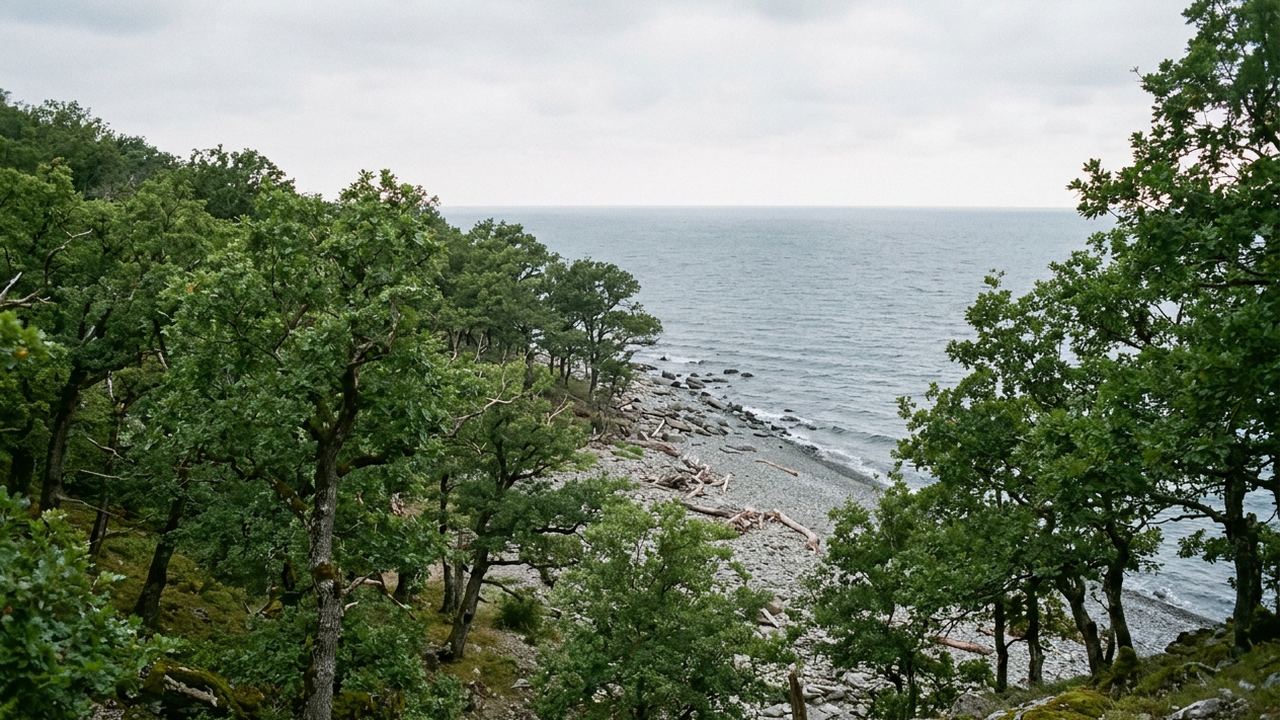
The high ground here is not high. The tallest summit on the Bulgarian side is a shade under 2,400 feet, and the walking is a matter of persistent small climbs rather than one long haul. What makes it work is the tree cover: oak, hornbeam, beech, and in the wet valleys an understorey of Pontic rhododendron and cherry laurel that is a survival from a much older, warmer forest and grows almost nowhere else in Europe. You walk in shade for hours. In July that is the difference between a pleasant day and a miserable one.
The record of the last several decades is of a long, mild season. Coastal water at Sinemorets has typically been swimmable from the first week of June through early October, sitting in the low seventies at midsummer and holding warmth into the fall better than the air does. Inland the forest runs five to eight degrees cooler than the coast on the same afternoon. Rain has come most heavily in May and again in November, and the tracks show it: the red clay on the Veleka side goes slick within an hour of a downpour and stays greasy for a day after. This is what the record has been. It is not a promise about the week you pick, and we do not make predictions.
A typical walking day is six miles with 900 to 1,300 feet of climb, spread across four to six hours including stops. You start early because the middle of the day is better spent in a village kitchen or in the water. Two of the three guided days end at a river or at the sea, which is deliberate: you finish sweaty and you get in.
Reserve this week if you would rather be bored than entertained
This suits people who are happy with long gaps. Forty five percent of your waking hours are decided in advance, which is roughly the middle of our catalogue: the walking days, the boat hour and the driver's schedule are fixed, and the rest is yours to fill or not fill. There is no evening program. In Kosti the evening program is dinner at the house and then dark. If that reads as a shortfall to you, reserve something else.
It also suits people who take a border seriously. The Turkish frontier runs along the south of this massif and the trip does not cross it. Some forest roads dead end at fencing and signage; a few areas near the line are restricted and our guides know which. We follow that without argument, and we do not sell, arrange or advise on entry documents of any kind, for Bulgaria or anywhere else.
The same twenty-four trips are printed in five orders. This one sits in a different place in each, and none of the five positions is a judgement about it.
- Hours in the air
- 18 of 24 at 13 hours. The whole order
- Miles walked a day
- 11 of 24 at 6 miles. The whole order
- Per cent decided in advance
- 13 of 24 at 45 per cent. The whole order
- From, per person
- 6 of 24 at $2,410. The whole order
- Different beds
- 8 of 24 at 3 beds. The whole order
What the season has been, late April through late October
- Late April to mid May
- Forest at its greenest and loudest with birds, wildflowers through the oak understorey. Water too cold to swim. Rain frequent, tracks often greasy, and two of nine nights may go to indoor evenings.
- Mid May to mid June
- The strongest stretch for walking: warm days, cool shade, sea approaching swimmable at the end of it. Village festivals fall here, including the third of June at Balgari. Rooms are easiest to hold now.
- Late June to mid July
- Sea reliably warm, beaches still close to empty on weekdays, weekends busier with Bulgarian families driving down from Burgas. Afternoon heat inland pushes walking earlier, typically starting by seven.
- Late July to mid August
- Hottest and busiest of what passes for busy here. Coastal rooms cost roughly $40 a night more and sell out first. Inland walking is limited to mornings, and one guided day is usually swapped for river time.
- Late August to late September
- Our own preferred stretch. Sea still warm, crowds gone by the first week of September, forest starting to color. Long stable spells have been common in the record. Rooms easier again.
- October
- Water still swimmable to about the tenth in most years. Forest color at its best, mushroom season, cool mornings. Several coastal kitchens close mid month, so dinners shift inland and choices narrow.
The border zone, the roads, and the thing nobody warns you about
The awkward fact is the driving. This trip is built on a hired car and a driver because the alternative does not function: the bus that connects the inland villages runs a few times a week and sometimes not at all, and the distances are short in miles and long in minutes. Malko Tarnovo to Sinemorets is under fifty miles and takes an hour and forty on a good day. Some of the connecting road is patched asphalt with edges that have crumbled into the ditch, and one link we use is unpaved for four miles. If you get carsick on winding roads, this will be the part of the week you remember, and no amount of scheduling around it will fix that.
The second thing is medical distance. The nearest hospital of any real capability is in Burgas, which is ninety minutes from the coastal rooms and two hours from Kosti. Cell coverage in the forest valleys is patchy and there are pockets with nothing at all. We plan around this and our guides carry what guides carry, but you should understand the geometry before you commit to it. This office does not sell travel insurance and gives no advice on it; we say only that the distances are what they are and you are an adult who can weigh them.