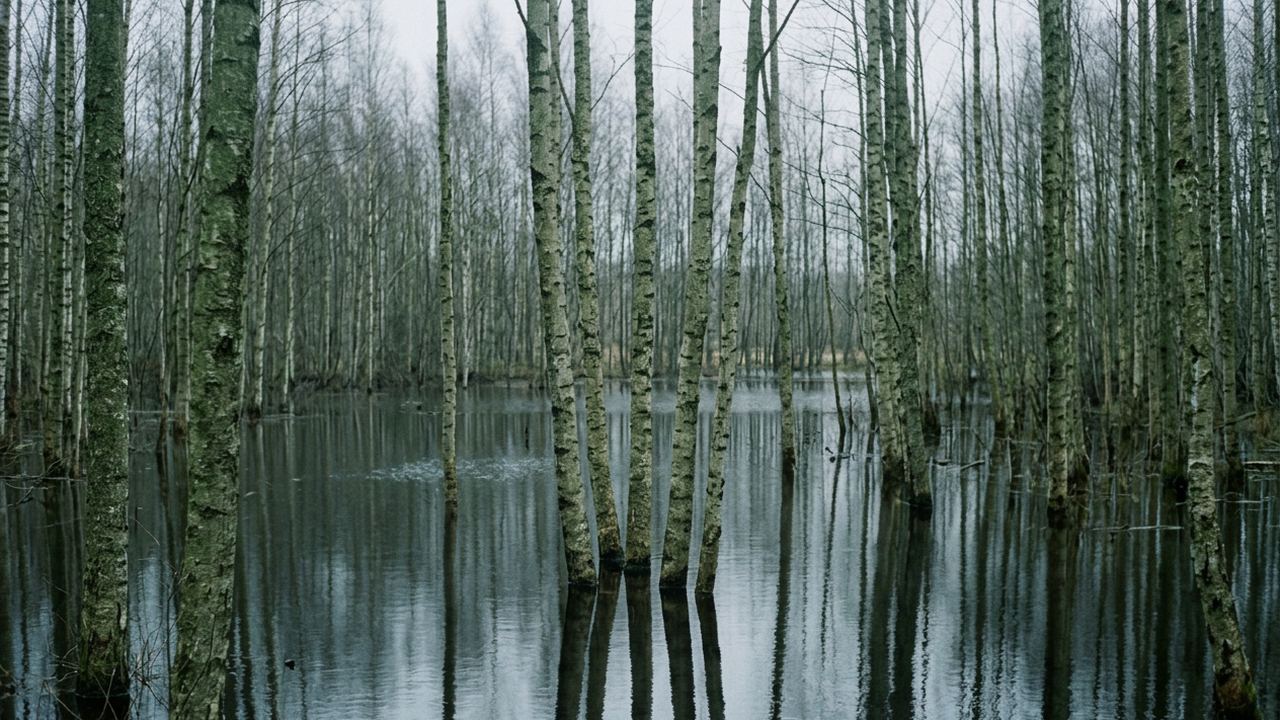
Photographs of Soomaa nearly always show the fifth season, which is the local name for the spring flood, and they show it from above: brown water lying between tree trunks, a canoe in the middle of what was a footpath. What the pictures cannot carry is the quiet, which is total and slightly unnerving, or the fact that the water is only about waist deep across most of its area. It is not a torrent. It is a whole landscape three feet under, moving so slowly that a floating leaf takes a minute to leave your hand behind.
The second thing people get wrong is the scale of the bogs themselves. Kuresoo, the largest of the four, is a raised dome of peat covering roughly nineteen square miles, and its southern slope drops about twenty six feet over a third of a mile, which is the steepest thing in the park and would not register as a slope anywhere with hills. You walk across it for two hours and see the horizon in every direction, broken only by stunted pines two feet tall that are two hundred years old. Visitors expecting Nordic drama find it monotonous for the first day and then, quite often, cannot stop looking at it.
Third: the flood is not scheduled. It happens when a winter's snow melts fast onto ground still frozen underneath, usually somewhere in the last week of March or the first three weeks of April, and in some years it barely happens at all. We say this at the point of reserving rather than after. If your week is booked for flood and the water does not rise, the guide takes the party out on the rivers instead, which is a good week and not the week you pictured.
- The week in one sentence
- Eight nights, seven in one timber guesthouse near the Riisa side of the park and one in Parnu before the flight home, with a driver moving the party and all luggage in a single van transfer at each end and nothing carried between beds.
- Why this and not the next one
- Parnu is the practical airport town but has no long haul service, so the party lands at Tallinn and drives two and a quarter hours southwest. The ground is peat, not rock: the highest point inside the park stands about 150 feet above the lowest, across nineteen miles. Beds are timber rooms in a family guesthouse, two per room, shared bathroom on the corridor. The season runs late March to late October, closed in the freeze. Eight nights, from $2,390 per person.
- Inside the figure
- Seven nights in the guesthouse with two people sharing and one night in Parnu; all breakfasts and seven dinners cooked in the house; the return van transfer from Tallinn airport; five days with a local guide licensed by the park; canoe, paddle and buoyancy aid on flood days; bog shoes and gaiters on dry days; the park entry and the two boardwalk trail fees; a dry bag per person for the boat days.
- Outside it, and what that runs to
- International flights, roughly $980 to $1,540 from Chicago or Dallas in shoulder season; lunches, which run $9 to $16 at the guesthouse or packed for the boat; the seven dinners you take in Parnu and on transfer days, about $22 to $40; the smoke sauna evening at $34 per person, which is booked separately because the house only heats it for four or more; alcohol; a private room without sharing, $310 for the week; laundry in the village, $12 a load; and the beaver dusk boat, $28, which we will not pretend is reliable because the animals decide.
- Reasons to book something else
- Do not reserve this if you cannot get in and out of a canoe unaided from a low muddy bank, or if you cannot walk five miles on ground that gives under you. Bog shoe days average five miles at roughly half normal walking speed, with no dry place to sit down for four hours at a stretch. Flood days mean six hours on a boat seat with no toilet ashore. There is no relief and no viewpoint: the country is flat for its whole width, and people who need a summit at the end of a day will be bored by the third morning.
Peat, water and the reason nothing here drains
The park sits in a shallow basin where five rivers meet within a few miles of each other, and the basin has no slope worth the name. Peat has been accumulating in it for about ten thousand years and now lies up to twenty three feet thick in the middle of the domes. Peat holds water the way a sponge does, releases it slowly, and sits higher in the middle than at the edges, which is why they are called raised bogs. The surface is a mat of sphagnum you can push a walking pole into up to the grip without hitting anything solid.
This is what the bog shoes are for. They are wooden or plastic frames about eighteen inches square, strapped over ordinary boots, and they spread your weight enough to keep you on top of the mat instead of in it. They work well and they feel ridiculous for the first twenty minutes. Walking pace on them is roughly half of normal, your stride widens, and you will fall over at least once, usually onto sphagnum, which is soft and wet and will not hurt you. Nobody in the party will be dry from the knee down after the first hour.
On the record of the last twenty years or so, the flood peaks in the first half of April and reaches around three to six feet above summer level on the Halliste and Raudna, with the exceptional years running higher and lasting into early May. Summer daytime temperatures sit in the high sixties and low seventies Fahrenheit, with July the wettest of the warm months. September and early October have been the driest stretch, with morning fog on the rivers and hard frost arriving somewhere in the second half of October. That is the record, not a forecast, and April 2020 produced almost no flood at all while April 2010 put water across the road at Riisa for eleven days.
Who does well here, on the evidence of the people we have sent
The people who come back pleased are the ones who wanted a specific thing: beaver, cranes, the flood itself, or the experience of a landscape with no vertical interest whatsoever. Photographers do well because the light on flat water is long and low for most of the day. So do people who like moving slowly under their own power without a summit at the end. The party spends five days out with a guide and two days loose, and the loose days are genuinely loose, which some people find generous and some find like being abandoned.
The people who do not do well are those who came to Estonia for the medieval streets of Tallinn and added Soomaa as an outdoor day. This is eight nights in a village with one shop, thirty five minutes from a town of eight thousand. There is no restaurant choice, no evening beyond the guesthouse table and the sauna, and phone signal that drops out on the bogs. Say the awkward thing plainly: if the idea of seven consecutive dinners with the same eight people at the same table sounds like a problem, it will be a problem.
The same twenty-four trips are printed in five orders. This one sits in a different place in each, and none of the five positions is a judgement about it.
- Hours in the air
- 14 of 24 at 12 hours. The whole order
- Miles walked a day
- 9 of 24 at 5 miles. The whole order
- Per cent decided in advance
- 23 of 24 at 72 per cent. The whole order
- From, per person
- 4 of 24 at $2,390. The whole order
- Different beds
- 3 of 24 at 2 beds. The whole order
What each stretch of the season has actually been like
- Mid March to late March
- Ice going out, roads soft, water rising in some years and not others. Cold and grey, high thirties to mid forties. The season low on van transfers and no other visitors anywhere.
- Late March to late April
- The flood window. Water in the forest in most years, canoe days on the Raudna, mosquitoes not yet arrived. Add roughly $140 for the extra guided boat days.
- May
- Water dropping, cranes and black storks nesting, bird activity at its highest. Bog shoes possible on the drier domes by mid month. Long light until ten at night.
- June to mid July
- Warmest and wettest of the warm months, high sixties to low seventies. Mosquitoes are severe on windless evenings and no repellent fully solves it. Full bog shoe access.
- Mid July to August
- Berry weeks. Cloudberry on the bogs early, then bilberry and cranberry. Locals in the park at weekends. Water low enough that some river sections are walked rather than paddled.
- September to mid October
- Driest and clearest stretch on the record, cool nights in the forties, river fog most mornings, the bogs turning rust and ochre. Best month for beaver sightings at dusk.
- Late October to November
- Frost hardening, birds gone, guesthouse heating on. Short days, dark by half past four. We stop taking requests for this stretch once the road at Riisa starts to freeze and thaw daily.
The mosquitoes, and the smoke sauna nobody warns you about
From roughly the second week of June to the middle of August, mosquitoes in Soomaa are as bad as anywhere in northern Europe. This is not a caveat we are burying. On a still evening on the bog edge there will be a cloud around your head that does not disperse, and the standard advice about repellent is only partly true: it keeps them off skin and does nothing about the noise or about the ones that find the gap between glove and cuff. Guides wear head nets in July without embarrassment and the guesthouse keeps spares. If insects genuinely distress you, take a week in late April or late September and accept a colder river.
The smoke sauna is the other thing people misjudge, in the opposite direction. It is a small windowless building heated for five or six hours by an open fire with no chimney, then aired out, and you sit in it at about 160 degrees Fahrenheit among soot-blackened walls. It is not a spa, there is no attendant, and the first ten minutes smell strongly of tar. Estonians take it seriously enough that the tradition is on a UNESCO list, and it is the single thing most guests write to us about afterward. It costs $34 per person and the house will only heat it for four or more, which means if two of you want it, you are waiting for two others to want it too. We do not add it to the figure because we cannot promise it will fire on the night you want.