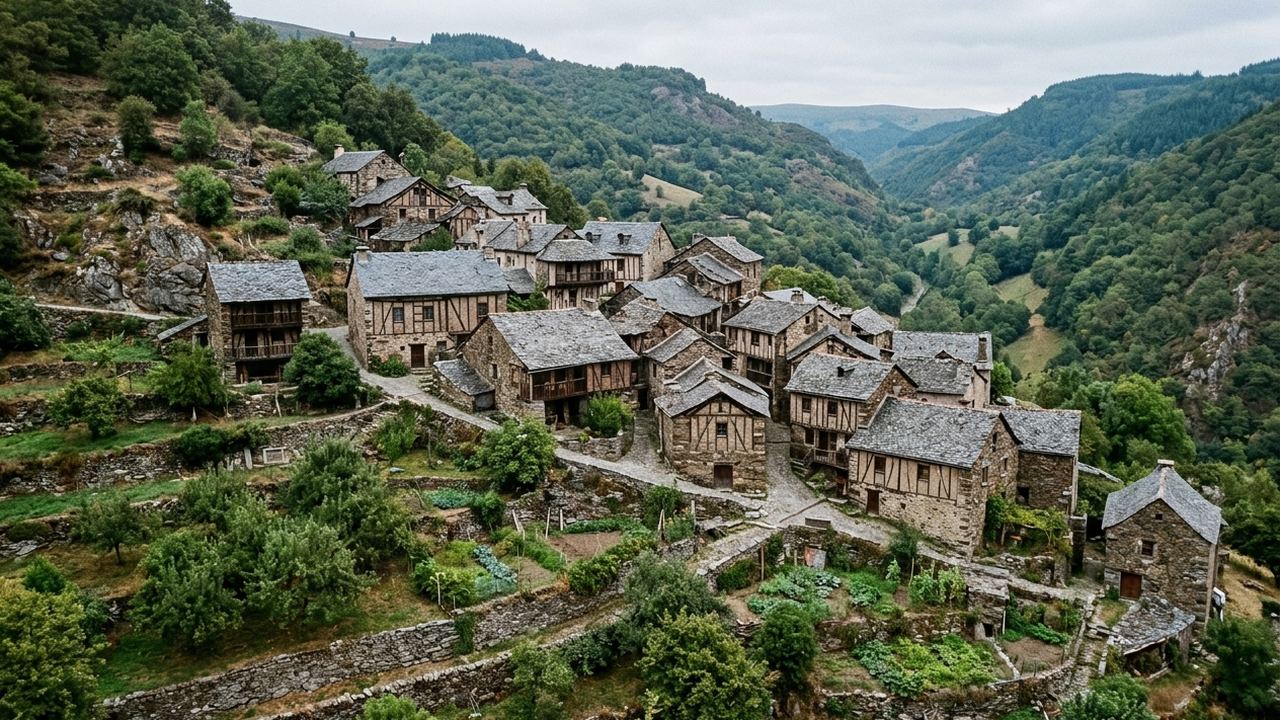
Photographs of these villages almost always come from the same twenty yards: the lower square at La Alberca, taken in the afternoon, with the timber galleries leaning over the street and nobody in the frame. What that angle leaves out is that La Alberca has a coach park, and between roughly eleven and four in high summer the lower square carries several hundred day visitors from Salamanca. The village is genuinely remarkable and the photograph is not a lie. It is just a photograph of one hour.
The rest of the range is close to empty. Mogarraz, four miles east, has fewer than three hundred residents and a wall of painted portraits of the people who lived in each house. San Martín del Castañar has a walled cemetery built inside the ruins of a bullring, which is the sort of thing you find by walking past it rather than by looking it up. Miranda del Castañar runs along a single ridge for half a mile and is barely wider than its one street. These are the places the week is actually built around, and the reason the walking matters is that the paths between them are the old connections: chestnut terraces, threshing floors, stone crosses at the junctions, a track that has been there long enough to be worn into the granite.
The other thing worth stating early is that this is not Andalusia and it is not the Camino. Nobody here is set up for foreign walkers in numbers. Menus are in Spanish, hotel owners often speak no English, and the walking is signed by the regional path network rather than by anything explanatory. That is why a guide is on four of the days and route notes cover the rest.
- The week in one sentence
- Eight nights in four family-run village hotels, two nights in each, walking between three of them on marked paths and moving by road once; a van shifts the main bags between hotels on walking days, so you carry a daypack.
- Why this and not the next one
- Madrid Barajas is the airport, then two and a half hours southwest by road; there is no useful train. The ground is granite and slate, steep on both faces, with old mule paths cobbled in places and loose in others. Beds are in restored village houses of six to fourteen rooms, not resorts. The season runs late March to mid November, closing hard when the high paths ice. Eight nights, from $2,190 per person, two sharing.
- Inside the figure
- Eight nights in four village hotels with private bathrooms, two people sharing; breakfast every morning; five dinners of the fixed regional kind, wine poured at the table; bag transfer between hotels on the three walking days; all road transfers including both airport runs; a local walking guide on four full days; paper route notes and a 1:25,000 map set for the days you walk alone; entry to the monastery church and the village museum at Mogarraz.
- Outside it, and what that runs to
- Flights, typically $780 to $1,340 round trip from central US airports; three dinners, budgeting $28 to $45 a head; all lunches, roughly $14 in a village bar and $9 if you carry bread and cheese; the tourist tax charged nightly by two of the four municipalities, $1.30 to $2.10 per person; anything you drink outside the five included dinners; single occupancy, which adds $560 across the week; boot hire, which nobody local offers, so bring your own; travel insurance, which this office does not sell or advise on.
- Reasons to book something else
- Do not reserve this if you cannot walk eight miles on rough, tilted ground with 1,600 to 2,400 feet of climb, four days out of eight, with no way to shorten a route once you are on it. The mule paths are cobbled with rounded granite that turns underfoot when wet, and there is no shuttle to collect you halfway. Three of the four hotels are old houses with stairs and no elevator, and one has bedrooms only on the second and third floors. Cell coverage drops out for stretches of two to three miles.
What the granite does underfoot, and what a walking day here actually costs you
The range tops out at Peña de Francia, 5,036 feet, with a Dominican monastery and a working meteorological installation on the summit. Almost everything else sits between 2,000 and 3,500 feet, which puts the villages high enough that summer nights cool off properly and winter closes the top road for days at a time. The rock is granite in the upper reaches and slate lower down, and the villages are built from whichever one was nearest, which is why Mogarraz reads dark and La Alberca reads pale from a distance.
Underfoot this means two different surfaces in the same day. The old mule paths are cobbled with rounded granite cobbles set on edge, superb drainage and lethal grip when wet. Above the terraces the paths become loose decomposed granite on a steep face, the kind that rolls. Between them run the chestnut terraces themselves, thousands of dry stone walls holding soil on a slope, some maintained and some collapsing into the path. A walking day is typically five to six hours moving, eight miles, and between 1,600 and 2,400 feet of climb, with the climb usually front-loaded because the villages sit in the valleys and the connections go over the shoulders.
On the record rather than any forecast: this is one of the wetter corners of interior Spain, catching Atlantic weather that has crossed Portugal, and the range holds a good deal more rain than Salamanca forty miles north. That is what grows the chestnuts. It also means that in any given week in April or October you should expect at least one day of it, and the granite cobbles will be slick for the whole of that day and part of the next.
The kind of walker who gets on with a week here
This suits people who are content with four to five hours of walking, four days out of eight, and content to spend the other days doing very little in a village of two hundred people. There is no nightlife, one bar per village, and dinner at nine. If the appeal of a place is that you can sit in a square on a Tuesday afternoon and watch three separate conversations conclude slowly, this is the week. If a rest day needs filling, it will not be.
It also suits people who are comfortable being outnumbered by a language they do not speak. The guide is with you on the walking days and the hotel owners are unfailingly patient, but ordering dinner in Mogarraz on a night without a guide is on you, and a phrasebook does more good here than it does in most of Spain.
The same twenty-four trips are printed in five orders. This one sits in a different place in each, and none of the five positions is a judgement about it.
- Hours in the air
- 6 of 24 at 10 hours. The whole order
- Miles walked a day
- 19 of 24 at 8 miles. The whole order
- Per cent decided in advance
- 21 of 24 at 58 per cent. The whole order
- From, per person
- 2 of 24 at $2,190. The whole order
- Different beds
- 17 of 24 at 4 beds. The whole order
Late March to mid November, as the seasons here have actually run
- Late March to late April
- Green, wet and cold at height, with the high paths sometimes still holding ice at dawn. Wild flowers on the terraces. Expect two wet days in eight and lower prices, around $1,940 per person.
- Early May to mid June
- The best walking of the year on the record: dry cobbles, 60s and low 70s by day, chestnut coming into leaf. Also the busiest, and the four hotels fill four months ahead at this stretch.
- Late June to mid July
- Hot in the valleys, 85 and above by two in the afternoon, so walking days start at seven and finish before noon. Villages are still quiet. Nights cool to the high 50s.
- Late July to end of August
- La Alberca fills. Coach visitors daily, Spanish family holidays in every hotel, and prices at their highest, around $2,480. Walking is early or not at all. The one stretch this office would steer you away from.
- September
- The most reliable month on the record. Warm, dry, the day visitors gone by the second week, chestnut harvest beginning on the terraces at the end of it. Prices back to $2,190.
- October to early November
- Chestnut and oak turning, the whole range going copper and rust for about three weeks. Wet more often than not. Mist sits in the valleys until ten some mornings, which is beautiful and slows you down.
- Mid November to mid March
- Closed. Two of the four hotels shut entirely, the Peña de Francia road ices, and there is no walking week to reserve.
The road day, the one nobody enjoys, and what the monastery is really like
Three of the four hotel changes are made on foot. The fourth is not: Miranda del Castañar to the final hotel is a road transfer of about fifty minutes, because the direct path crosses private ground and the legal route adds nine miles of tarmac to a day that is already long. It is a dull hour in a van and it is the honest shape of the week. Anyone selling you eight nights of pure village-to-village walking in this range is either adding that tarmac or crossing a fence.
The monastery on Peña de Francia is worth setting expectations about too. It is a real Dominican house, founded in the fifteenth century, and the summit view on a clear day reaches into Portugal. It is also reached by a paved road that carries cars right to the top, there is a bar up there, and the buildings have been rebuilt often enough that little of the original fabric shows. You walk up, which takes about three hours from the col and is a genuinely fine climb through broom and granite, and then you share the summit with people who drove. That is not a reason to skip it. It is a reason not to be surprised.