The photographs almost always show the same three things: a white-clad figure from behind, a mossy stone lantern, and cedar trunks in fog. What they leave out is the asphalt. A very large share of this circuit runs along the shoulder of a two lane prefectural road with a guardrail on your left and a concrete drainage channel on your right, trucks passing at forty miles an hour, and a convenience store every eight or nine miles that becomes the most important building in your day. The forest sections are real and they are beautiful, and on this stretch they add up to maybe a third of the walking.
The second thing people get wrong is the number 88. They hear it and picture 88 destinations. In practice the temples are punctuation, not content: you arrive, you wash your hands, you say what you came to say or you do not, you have the book written, and you are out in twenty minutes. The circuit is the walking between them. This section covers eleven of the numbered temples and one unnumbered hall that most people skip, and if you tried to spend an hour at each you would miss your inn.
The third thing is that this is not a wilderness route. It goes through working towns with hardware shops and dentists and elderly men cutting hedges. People will stop you. The custom of giving something small to a walking pilgrim is alive on this island, and over nine days you can expect a can of coffee pressed into your hand, a tangerine, sometimes a folded bill you are not supposed to refuse. This unsettles some travelers more than the mountains do.
- The week in one sentence
- Nine nights: seven in family-run inns with shared bathing, one in a temple guest hall with a shared sleeping room, one near the airport at the end. You walk between them every day carrying a daypack, and your main bag is forwarded ahead by the domestic parcel service.
- Why this and not the next one
- Takamatsu is roughly fifteen hours in the air from the middle of the country, usually two flights and a domestic hop or a two hour train. The ground is asphalt shoulder, river levee, cedar forest track, and long flights of cut stone: the two mountain temples on this section put 2,300 and 1,750 feet of climb into a single morning. Beds are futons on tatami with an evening and morning meal cooked by the family. Sections run mid March to early June and mid September to late November. From $2,680 per person.
- Inside the figure
- Nine nights of accommodation with two meals a day at the inns and the temple guest hall; the temple lodging booking, which cannot be made online and is placed by telephone in Japanese; daily forwarding of one main bag between inns; a printed strip map with the day's water points, closures and bail-out bus stops marked; the pilgrim's white stole, book and staff bought at the first temple; airport to first inn transfer; a rail pass valid for the two transfer days; a written route sheet giving each day's mileage, climb and the last hour at which a bed will still hold for you.
- Outside it, and what that runs to
- International flights, generally $1,150 to $1,900 from a central US hub; lunch and anything you drink, budget $22 a day since the route runs long stretches with one vending machine and no shop; temple stamp fees at $2.50 a temple, which is $47 across this section if you have every page written; coin laundry at roughly $5 a load and you will want it every third night; the $60 to $90 a night surcharge if you want a single room rather than sharing, and it is not available at the temple; taxi or bus if you decide at 3pm that you cannot finish the day, usually $18 to $55; cover of any sort, a thing this desk does not deal in and will not comment on.
- Reasons to book something else
- Do not reserve this if you cannot walk eleven miles a day for nine days in a row on hard surfaces, or if 2,300 feet of climb on uneven stone stairs is beyond you on a hot morning with a pack. There is no vehicle following the group. Inns are up a flight of stairs, bathing is communal and unclothed, toilets are sometimes squat, and the bed is a futon on the floor. Nobody on the route speaks much English. If you need a private bathroom every night, this is the wrong week.
What eleven miles a day does to your afternoons
The shape of the day is set by the inns, not by the temples and not by you. Family-run lodging on this route cooks dinner at six and expects you between three and five so the bath can be heated and the fish can go on. That means a 6:30am start if the day carries a mountain temple, and it means the day effectively ends at four whether or not you feel like walking further. Two of the nine days are short, around seven miles, because there is nowhere to sleep between the obvious stopping points. Two are long, fourteen and thirteen miles, for the same reason in reverse.
Weather here is a record, not a promise, and the record for this island is wet. The southern coast of Shikoku catches more rain than almost anywhere else in the country, and even the sheltered northern side has run 55 to 60 inches a year. In practice: October has been the driest month on the walking calendar of this route, June the wettest by a wide margin, and afternoon rain in September has been common enough that experienced walkers on this section start earlier in that month than in any other. Bring a rain jacket that actually works and accept that your boots will be wet on at least two mornings.
Temperature has run 45 to 60 degrees in March and 50 to 68 in November, both comfortable for climbing. May and September have both delivered days above 85 with high humidity, and on those days the stone stairs are genuinely dangerous: people have needed help off the mountain approaches in that heat, not from injury but from stopping sweating. The office will move a mountain day earlier in the itinerary if the record for your dates suggests heat, and will say so in writing when the figure is priced.
The kind of walker who finishes this section
This suits someone who has already done multi day walking and knows what their feet do on day four. Hard surfaces are the specific issue: eleven miles of asphalt is harder on the joints than fourteen of trail, and the people who struggle here are usually strong hill walkers who have never done consecutive days on road. If your training has all been on dirt, add road miles before you come.
It also suits someone comfortable being illegible. You will not understand what is said to you, the inn will not be able to explain the dinner, and you will sit on a floor eating six small dishes you cannot name. People who find that interesting have a good week. People who need to be in control of their circumstances tend to have a hard one, and it usually shows on the third or fourth night rather than the first.
The same twenty-four trips are printed in five orders. This one sits in a different place in each, and none of the five positions is a judgement about it.
- Hours in the air
- 22 of 24 at 15 hours. The whole order
- Miles walked a day
- 24 of 24 at 11 miles. The whole order
- Per cent decided in advance
- 7 of 24 at 40 per cent. The whole order
- From, per person
- 12 of 24 at $2,680. The whole order
- Different beds
- 24 of 24 at 9 beds. The whole order
Nine seasons of records from this section of the route
- Mid March to early April
- Cold mornings around 40 degrees, dry ground, bare hills. Cherry along the river levees in the first week of April. Inns are quiet and easy to hold. Some mountain huts still shut.
- Mid April to late May
- The strongest stretch on the record: 60 to 75 degrees, long light, everything green. Also the busiest, so the temple guest hall fills eight to ten weeks out and dates move if you delay.
- Early June to mid July
- The rainy season. Whole days of steady rain, trails running with water, 80 percent humidity. Leeches on two forest sections. We do not sell this section then.
- Mid July to early September
- 88 to 95 degrees with no wind in the valleys. The stone stairs become the whole problem. This section is closed for reservations.
- Mid September to mid October
- Heat breaking, typhoon tail ends possible, one or two afternoons of hard rain likely. Fewer walkers than spring. Add $0, but build in the bail-out bus stops.
- Mid October to late November
- The driest stretch on record and the second strong window: 50 to 68 degrees, maples on the mountain approaches from the first week of November, early dark by 5pm.
- December to early March
- Cold, 32 to 48 degrees, ice on the north-facing stone steps above 1,500 feet. Several inns close for the winter. Not offered.
The stairs, the stamp book, and the bag that arrives before you do
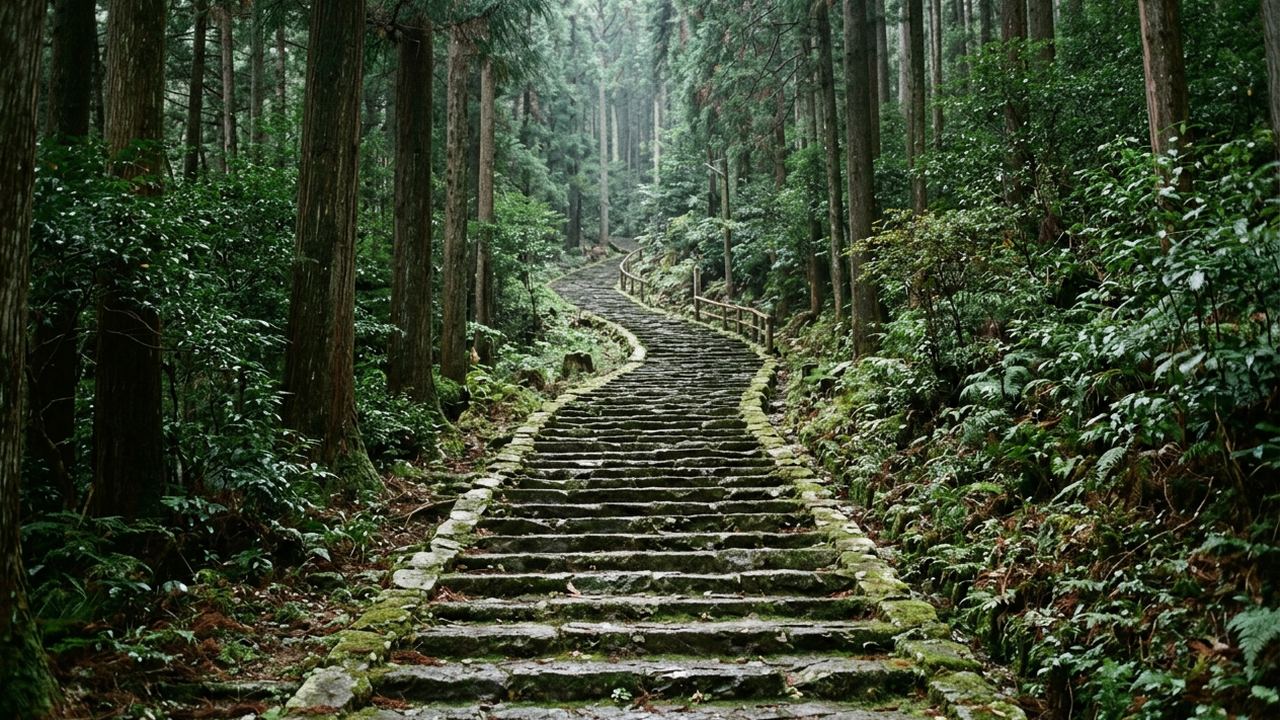
The awkward part is the stone. Two of the temples on this section are reached by stairs cut into the mountain, several hundred steps each, uneven in depth and worn slick in the middle where six centuries of feet have polished them. There is no handrail on the older flights. Coming down is worse than going up, and it comes at the end of a morning when your legs are already loaded. One walker in perhaps eight on this section finishes a mountain day with knees that need the following morning off, which is why the day after each climb is short by design rather than by accident.
The expensive annoyance is the bag forwarding. It works, it is reliable, and it costs about $14 a leg, which is inside the figure quoted above. What it does not do is run on your schedule. The bag leaves the inn mid morning and arrives at the next inn late afternoon, sometimes after you do. If you walk in at three soaked through, your dry clothes may be an hour behind you. Carry one dry layer in the daypack and stop resenting it. The office cannot make the parcel network go faster and will not tell you it can.