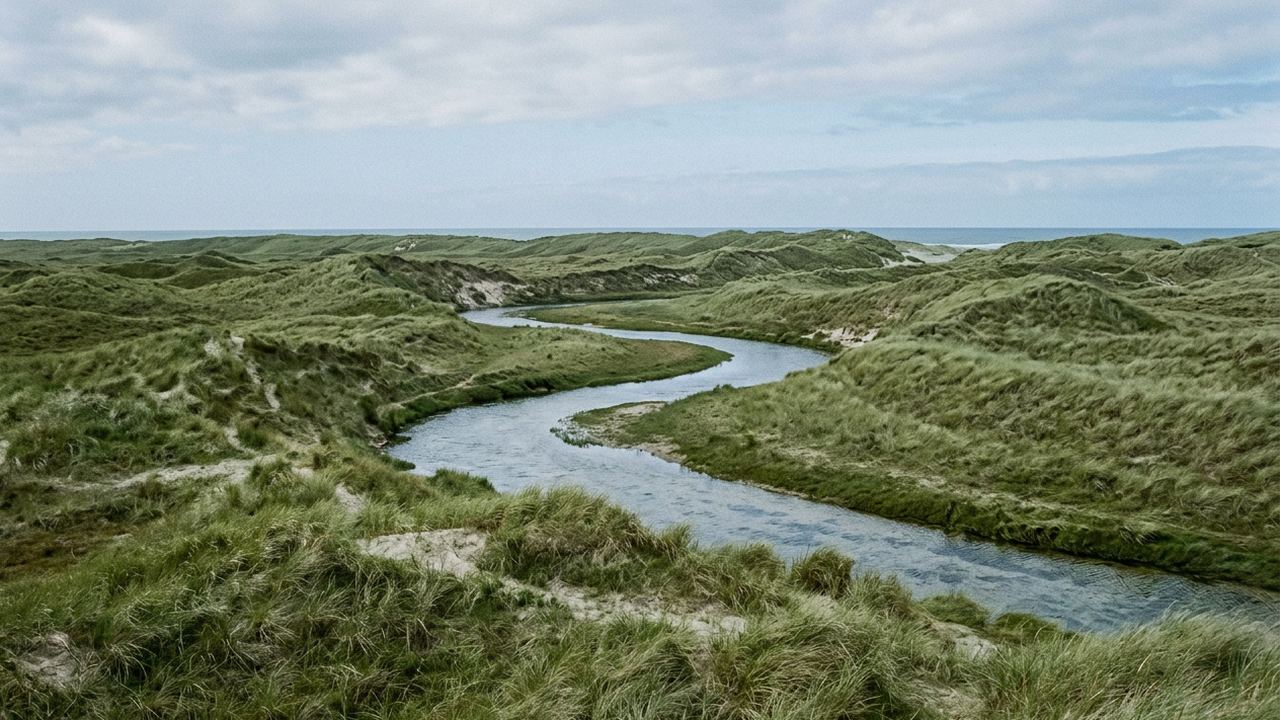
Photographs of the Sandhills are almost always taken from a low rise looking across grass, which flattens everything and makes the country look like a lawn. What the frame leaves out is the vertical. These are dunes, some of them 300 feet from base to crest, and they are among the largest sand dunes in the western hemisphere. Grass holds them still. Where the grass is broken, by a road cut or a heavy hoof line or an old plow scar from a farmer who tried and left, the sand starts moving again within a season and does not stop. That is why the ranches here run cattle rather than crops and why they are as protective of root mat as a vintner is of old vines.
The second thing photographs leave out is the water. A quarter of Nebraska sits on top of the High Plains aquifer at its thickest, and the water table in the hills comes up to meet the surface in the low ground between dunes. The result is that a place with fourteen to twenty three inches of annual precipitation is full of lakes, marshes and rivers that run clear and cold and do not flood in a hard rain, because the sand takes the rain straight down. You float the Niobrara over a gravel and sand bed with springs coming in off the cliffs on the south side. The water is roughly 68 degrees in July, which is warmer than most spring-fed water and colder than most people expect.
The third thing is distance, and this is what changes the trip. Cherry County is 6,000 square miles and holds around 5,500 people. Ranch headquarters sit anywhere from four to thirty miles apart. A neighbor is someone forty minutes away. This is not scenery to be visited between meals; it is the operating condition of every day you are here, and the reason nine nights makes sense where five would be spent almost entirely in the car.
- The week in one sentence
- Nine nights in three beds across four stays: three nights at a working cattle ranch north of Mullen, two at a guest ranch on the Niobrara, two in a small hotel in Valentine, two back at the first ranch; you drive your own rental between them and your bags stay in the car.
- Why this and not the next one
- The nearest airport worth using is Omaha, five and a half hours east by car, or North Platte with a small-plane connection and no rental counter open late. The ground is sand under six inches of root mat, so it drains in minutes and holds no mud. Beds are ranch bunk rooms with shared bathrooms, a river guest ranch with private baths, and a plain hotel in Valentine. Season runs late April into early October. Nine nights, from $2,640 per person.
- Inside the figure
- Four beds for nine nights with two people sharing; all meals at the two ranches, twelve of them cooked in a ranch kitchen; two half days of river float on the Niobrara with tube, cooler and shuttle; a morning out with a ranch hand checking water tanks by pickup; two guided walks on private dune pasture with the landowner present; the crane viewing blind on the Platte for one dawn in the spring window; all gate keys, pasture access permissions and landowner arrangements, which cannot be obtained on your own; a written route card with mileages between every bed and the last fuel before each stretch.
- Outside it, and what that runs to
- The rental car, which runs $340 to $520 for the week from Omaha and must be a vehicle you are willing to take twenty miles on sand and gravel; fuel, roughly $90 to $140 for the whole loop; the two nights in Valentine cover the room only, so figure $30 a person a day for food there; alcohol anywhere; the state park entry sticker at $8 a day or $38 for the year; guided fly fishing on the Dismal at $375 for a half day with one guide for two rods; any air fare or connection into Omaha; laundry, of which you will want one load around night five.
- Reasons to book something else
- Do not reserve this if you will not drive. There is no transfer, no shuttle between beds, no taxi in three of the four places you sleep, and the longest single leg is 118 miles with one fuel stop that closes at seven. Cell coverage drops to nothing for stretches of forty minutes. Walking is easy, four miles on an average day with no climb worth naming, but the ground is loose sand on the dune faces and turns the ankle of anyone who cannot look down while walking. Two ranch beds are bunk rooms with a shared bathroom down the hall.
Sand under a root mat, and what that does to a day
The soil is 90 percent sand and more in places, with a thin layer of organic matter at the top that took several thousand years to build. Step off the two-track onto a dune face and you sink to the ankle. Step back onto the flat between dunes and the ground is firm enough to drive on. That contrast governs where you walk, what a guided walk looks like, and why the walking here is measured at four miles a day and not ten. Twenty miles of dune faces would be a serious undertaking. Four miles across a mixed section of flat and slope is a pleasant morning.
On the record, the season runs hot and then turns quickly. Late June through August has run in the high 80s and low 90s by afternoon, with a handful of days over 100 most years, and drops twenty five or thirty degrees after sundown because there is no humidity and nothing to hold the heat. Nights in late May and September have gone into the 40s. Wind is the constant nobody photographs: fifteen miles an hour is an ordinary afternoon, and thirty is common enough that the ranches build windbreaks on the north side of everything. That is a record of what has happened here, not a statement about the week you pick.
Storms in June and July arrive from the west in the late afternoon, are visible for an hour before they land, and pass in forty minutes. The floating stops when they do. Nobody argues about it.
Reserve this if the drive is part of what you came for
This suits people who are comfortable being the only vehicle on a road for half an hour, who can read a paper route card, and who find a landscape of grass and water and sky sufficient without a town at the end of it. It suits amateur astronomers particularly. Cherry County has some of the lowest measured light pollution in the lower forty eight, and on a moonless night the Milky Way casts enough light to see your hand. We say nothing about which nights are moonless; check that yourself before you pick dates, because it matters more here than the weather does.
It suits birders in the spring window, when several hundred thousand sandhill cranes stage on the Platte two hours south and you can be in a blind before dawn on one morning of the trip. It does not suit anyone who wants a program. Forty five percent of the waking hours are decided in advance, which is the middle of what this office sells, and the rest is yours with a car and a map.
The same twenty-four trips are printed in five orders. This one sits in a different place in each, and none of the five positions is a judgement about it.
- Hours in the air
- 3 of 24 at no flight. The whole order
- Miles walked a day
- 4 of 24 at 4 miles. The whole order
- Per cent decided in advance
- 12 of 24 at 45 per cent. The whole order
- From, per person
- 11 of 24 at $2,640. The whole order
- Different beds
- 6 of 24 at 3 beds. The whole order
What the season has done here, late April through October
- Late April to mid May
- Crane staging on the Platte is over by about April 10, so this stretch misses it. Grass is still brown at the start and green by the end. Nights in the 30s and 40s. Fewest other visitors of any window.
- Mid May to mid June
- Prairie chicken booming grounds are winding down but ranch calving is finished and the hands have time to talk. Rivers running full and cold, around 60 degrees. Most reliable stretch for wildflowers on the dune faces.
- Mid June to late July
- Floating season proper. Water around 68 degrees, air in the high 80s, afternoon storms two or three days a week. This is when the Niobrara is busiest, meaning perhaps two hundred people on a Saturday over twenty miles of river.
- August
- Hottest and driest. Several days over 95 most years. Water levels drop and one shallow stretch of the float gets walked rather than paddled. Grasshoppers in numbers. Nights are excellent and clear.
- September
- Widely considered the best of it and priced the same. Days in the 70s, nights in the 40s, the grass turning copper and rust across the whole horizon. Floating still possible in the first two weeks if you accept 60 degree water.
- Early October
- Ranch work turns to shipping cattle, which is worth seeing and which means the hands are unavailable for half a day at a time. First hard freeze usually mid month and the trip closes with it. Nights are the darkest of the year.
The part nobody enjoys hearing about: it is nine hours of driving
Across nine nights you will drive somewhere between 700 and 900 miles, most of it on two-lane highway at 65 and roughly ninety miles of it on sand and gravel county road. The route card breaks that into legs, and no single leg is over 118 miles, but the total is real and it is the single largest physical fact of the trip. People who dislike driving find this out on day three and there is nothing to be done about it by then. There is no train, no bus that goes where the beds are, and no arrangement this office can make that moves you between a ranch north of Mullen and a hotel in Valentine without a vehicle you are steering.
The second awkward thing is the rental car itself. Agencies in Omaha write contracts prohibiting travel on unpaved roads, and three of the all three are reached by unpaved road. Every visitor to this country solves this quietly and we would rather say it out loud: read your contract, choose a vehicle with reasonable clearance and a full-size spare rather than a compressor kit, and understand that a flat forty miles from pavement is your problem to fix. Two of the ranches will send a pickup if you can reach a phone. That may take an hour and a half. Amber Almanac does not sell insurance of any kind and does not advise on what the rental company offers you at the counter.