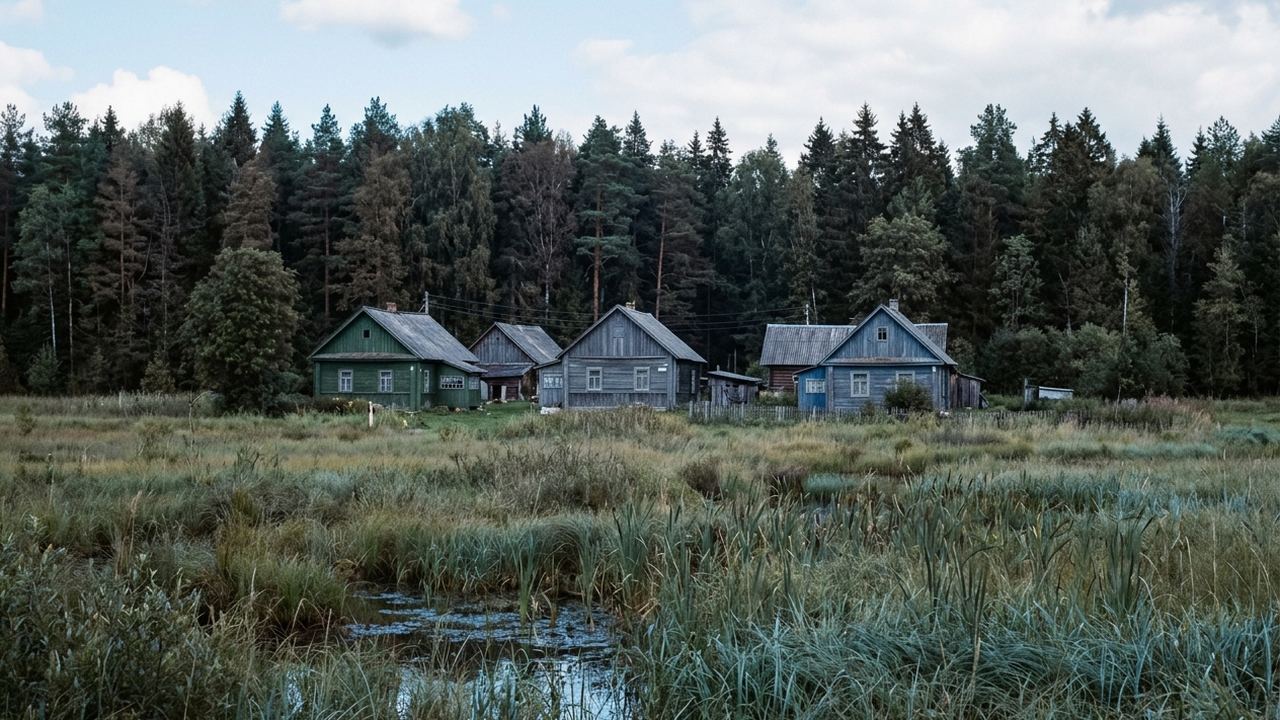
The photographs from this corner of Poland almost always show one thing: a wooden house front painted in blue and white and green, window frames cut into scallops and hearts, a woman in a headscarf at the gate. Those houses are real and you will stand in front of a good number of them. What the photographs leave out is that the painted villages are strung along thirty miles of road, that many of the houses are empty, and that the paint is maintained by people in their seventies who are the last of their families to live there. It is not a preserved district. It is a working landscape with a shrinking number of workers in it, and the honest way to see it is to walk between the villages rather than be driven from photograph to photograph.
The second thing people get wrong is the forest. Bialowieza is often described as the last primeval lowland forest in Europe, which is nearly right and worth stating exactly. The strict reserve, roughly 40 square miles of it, has never been clear felled and has stands where oaks are over 400 years old and dead timber is left where it falls. That part cannot be entered without a licensed guide, and the rule is enforced. The rest of the forest, including everything on the Polish side outside the reserve boundary, is managed woodland of great age and much freer access. Both are worth your days. Only one of them is what the phrase means, and this office will not blur the two to make the week sound larger.
The third thing is water. Podlasie is the flattest and wettest part of the country, and the Biebrza marshes are among the largest undrained river marshes left in Europe. On the wrong week in spring the meadow paths are not paths, they are shallow lakes with markers in them. We schedule around that, and we still put you on a plank causeway for hours at a time, and you will be glad of rubber boots on at least three days out of nine.
- The week in one sentence
- Nine nights in four places: three in a family guesthouse in the Biebrza villages, two in a wooden house near Kruszyniany, three by the forest at Bialowieza, one last night in Bialystok, with a driver moving the party and the luggage between them by road.
- Why this and not the next one
- Warsaw is the practical airport, then three and a half hours east by road, or the same by train to Bialystok and a driver from there. The ground is flat, wet and soft: peat, board causeway, mown meadow, sand track through pine. Beds are family guesthouses and one wooden village house, private rooms, shared bathrooms in two of the four. The season runs late April to late September, closing when the meadow paths are cut and flooded again. Nine nights, from $2,940 per person.
- Inside the figure
- Nine nights in private double rooms; all breakfasts and seven dinners cooked in the houses; a driver and vehicle for all four transfers and for six morning drop-offs at trailheads; a licensed guide for the two days inside the strict reserve, which cannot legally be entered otherwise; two half days on the water with a boatman, one punt and one flat-bottomed river boat; entry permits and reserve fees for Biebrza, Narew and the national park; a scope on a tripod carried by the guide on four mornings; the written route notes and paper maps for the six unguided days; airport or station pickup at either end.
- Outside it, and what that runs to
- International flights, usually $780 to $1,340 round trip from the middle of the country; the Warsaw to Bialystok train if you prefer it to the road transfer, about $18 to $34; lunches, which are $6 to $12 in village shops and often nothing at all on the forest days because there is nowhere to buy anything; two dinners left free in Bialystok and Kruszyniany, $9 to $22; rubber boots, which you can rent locally for about $5 a day and will want for at least three days; any museum or open air skansen entry, $3 to $7 each; tips, which are not expected but are taken; anything at all to do with entry documents, which this office does not sell or advise on.
- Reasons to book something else
- This is a walking trip on wet ground: six miles on an average day, nine on the longest, on peat and plank causeway that gives underfoot and has no handrail. There is no climb worth naming and no altitude, which is exactly why people underestimate it. Mosquitoes in June and July are severe enough to end a morning. Two of four houses have shared bathrooms and none has a lift. If you want a hard surface underfoot, a private bathroom every night, or a trip you can leave halfway, reserve something else.
What the ground does underfoot, and what nine mornings actually look like
Nothing here is steep. The whole region sits between about 300 and 600 feet above sea level, and the largest rise you will make in a day is the sandy ridge behind Kruszyniany, which is a matter of 130 feet. What tires people is surface. Peat gives half an inch under every step and takes energy back on every step, and six miles of that is heavier work than eight miles on a hard track. The board causeways in the marsh are single planks laid end to end, usually wet, sometimes tilted, with no rail. They are not dangerous at walking pace. They do demand that you look down, which is a particular frustration when the point of standing there is to look up.
A normal morning: breakfast in the house between six and seven if there are birds to see, the driver takes the party twelve to twenty minutes to a trailhead, then four to seven miles on foot ending at a road or a village where the driver is waiting. Afternoons are unbooked. Roughly 45 percent of the waking hours of this week are decided before you arrive, and most of that is the two guided reserve days, the two boat half days, and the six drop-off times. The rest you spend as you like, and several people spend it asleep.
On the record rather than as any kind of prediction: May and June have run warm and long by day, 63 to 75 degrees, with light until nearly nine in the evening, and the marsh in full voice. July and August have been hotter, into the eighties in recent years, with the meadows cut and the birds much quieter. Late September has run cool, 50 to 61 degrees, with the forest turning and almost no one in it. Rain has come in all three stretches. We are describing what the seasons have been, not what yours will be.
The people who come back from this week satisfied
They tend to be walkers who do not care about summits, and people who are genuinely interested in birds without needing to have counted them. The Biebrza holds aquatic warbler, great snipe, corncrake and something in the region of 270 recorded species, and there is a real difference between a person who is content to stand still in a meadow for forty minutes and a person who is not. The scope comes out on four mornings. Nobody is asked to use it.
The other group is people interested in the minorities of the border, which is the quiet subject of the middle of the week. Kruszyniany and Bohoniki have wooden mosques built by Tatar settlers granted land here in the seventeenth century, still standing, still in use, with cemeteries in the woods behind them. There are Orthodox parishes across the region with services in Church Slavonic, Belarusian spoken in villages, and Catholic parishes a mile away. These are living congregations rather than exhibits, and we visit at times agreed with the people who look after them.
The same twenty-four trips are printed in five orders. This one sits in a different place in each, and none of the five positions is a judgement about it.
- Hours in the air
- 13 of 24 at 12 hours. The whole order
- Miles walked a day
- 10 of 24 at 6 miles. The whole order
- Per cent decided in advance
- 11 of 24 at 45 per cent. The whole order
- From, per person
- 17 of 24 at $2,940. The whole order
- Different beds
- 16 of 24 at 4 beds. The whole order
What each stretch of the season has actually given us
- Late April to mid May
- Water high, meadows partly flooded, causeways at their wettest. Cranes and snipe displaying at dawn. Costs you: cold early starts near freezing, and two or three route substitutions on foot.
- Mid May to mid June
- The strongest stretch for birds and the busiest. Long light until almost nine. Costs you: mosquitoes bad enough to shorten a morning, and guesthouse rooms booked months out.
- Mid June to mid July
- Meadows tall, aquatic warbler still calling in the Biebrza, forest deep green and shaded. Costs you: heat into the high seventies on open marsh, and horseflies on the sandy tracks.
- Mid July to late August
- Hay cut, walking easiest of the whole year, sightlines open. Costs you: birds largely silent, midday heat in the eighties in recent years, and the forest paths busiest with Polish holidaymakers.
- Early to late September
- Cool, 50 to 61 degrees, mushrooms in the pine forest and whole villages out collecting them. Costs you: light gone by seven thirty, some guesthouse kitchens closing early, and boatmen finishing for the year.
- Late September onward
- Closed. The river boats are lifted, the meadow paths flood, and two of the four houses shut for winter. Nothing is run here after the last week of September.
The border is closed, and it changes the shape of the week
The forest is one forest and the frontier runs through the middle of it. On the eastern side is Belarus, and since 2021 the Polish side of that border has carried a steel barrier and a controlled zone that has, at various times, been closed to the public entirely. What that means for you in practice is simple and worth saying before you reserve rather than after: several of the walking routes that appear in older guidebooks now end at a fence, the eastern edge of the strict reserve is not always accessible even with a licensed guide, and there are days when uniformed patrols pass you on the track. Nothing about the trip is unsafe and nothing about it is dramatic. It is simply narrower than the map suggests, and we build the route from what is open in the month you travel, not from what was open once.
The second awkward thing is money and value, plainly stated. Nine nights at $2,940 per person is not a low figure for this part of Poland, and you could unquestionably do a version of this week yourself for less, because guesthouse rooms here run about $40 to $70 a night and a village dinner is under ten dollars. What the figure buys is the licensed guide for the strict reserve, which is not optional and not cheap, two boatmen, a driver on call for nine days in a region with almost no public transport between villages, and the fact that four separate family houses, two of which do not answer email, are expecting you on named dates. If that arithmetic does not appeal to you, that is a reasonable conclusion and we would rather you reached it now.