The Morvan gets described as the wild heart of Burgundy, which is accurate about the trees and misleading about everything else. This is a worked landscape. The forest is beech and Douglas fir planted for timber and cut on rotation, the clearings hold white Charolais cattle who are the actual economy of the place, and the four big reservoirs were dug to control the Yonne and to float firewood down to Paris in the nineteenth century. Nothing here is untouched. It is simply a piece of France that industry looked at and declined.
Photographs leave out three things. The first is the altitude: Mont Beuvray tops out at 2,700 feet and the whole massif sits high enough that it is reliably eight to twelve degrees cooler than Dijon on the same afternoon, which matters in July and is unwelcome in May. The second is the gradient. The hills are low but they are relentless, folded into short steep pitches with a stream in every crease, and a seven mile day here contains more climbing than a ten mile day in the Loire. The third is the emptiness, which is not romantic. The Morvan has been losing people for a hundred and fifty years. Villages of three hundred contain a bakery, a bar that closes at eight and often nothing else. If you drive out for lunch at one in the afternoon you may find every kitchen in a ten mile radius shut.
What you gain from that is the thing that is genuinely rare in western Europe: you can walk a full day in high season and pass four people. We have had parties finish an afternoon on the ridge above Lac des Settons, in the second week of August, and count one other pair of boots.
- The week in one sentence
- Nine nights in three village bases of three nights each, all rooms with private bathrooms in family run places, moved between by a small rental car you drive yourselves, with luggage staying in the car and never transferred by anyone else.
- Why this and not the next one
- Lyon is the nearest useful airport at two hours and forty minutes by road; Paris is four hours and most people wrongly assume it is closer. The ground is granite, not limestone, so the paths drain badly and stay soft into June. Beds are three family run village hotels, six to fourteen rooms each, no elevators, second floor stairs. The season runs late April to mid October, and it closes because the kitchens close, not because the weather does. From $2,880 per person, two sharing.
- Inside the figure
- Nine nights in three village hotels with private bathroom and breakfast; a compact rental car with unlimited mileage collected and returned at Lyon airport; every dinner but two, taken at the hotel where you are sleeping; a printed set of walking routes at 1:25,000 with the gates and stiles marked; entry to the Gallo-Roman site at Bibracte on Mont Beuvray and its museum; two half days with a local walking guide who lives in the park; a Morvan regional park pass covering the reservoir parking and the four small local museums; one afternoon of cheese and cattle at a working farm above Saint Brisson; and a phone number for the office in Lincoln that a person answers on working days.
- Outside it, and what that runs to
- Flights, which run $860 to $1,540 round trip from Chicago or Minneapolis depending on month; the fuel, roughly $95 across the nine days at French pump prices; motorway tolls between Lyon and the park edge, about $34 each way; the rental car deposit hold of 1,200 euros on a credit card at the desk, released some days after return; two dinners left deliberately open, $30 to $70 for two; lunches, which in the Morvan means the village bakery at about $9 a head because there is often nothing else; any drink not water; travel insurance, which this office does not sell or advise on; and the second driver fee of about $45 if you want to split the driving.
- Reasons to book something else
- Do not reserve this if you cannot walk seven miles on soft ground with 900 to 1,400 feet of climb, four days out of nine, and get in and out of a small car twelve times a day. Do not reserve it if nobody in the party will drive a manual car on lanes that narrow to one vehicle with grass down the middle. It is wrong for anyone who wants a town with more than one restaurant, for wheelchair users, and for anyone who needs a hotel elevator or a room reachable without stairs.
Granite, beech and a stream in every fold
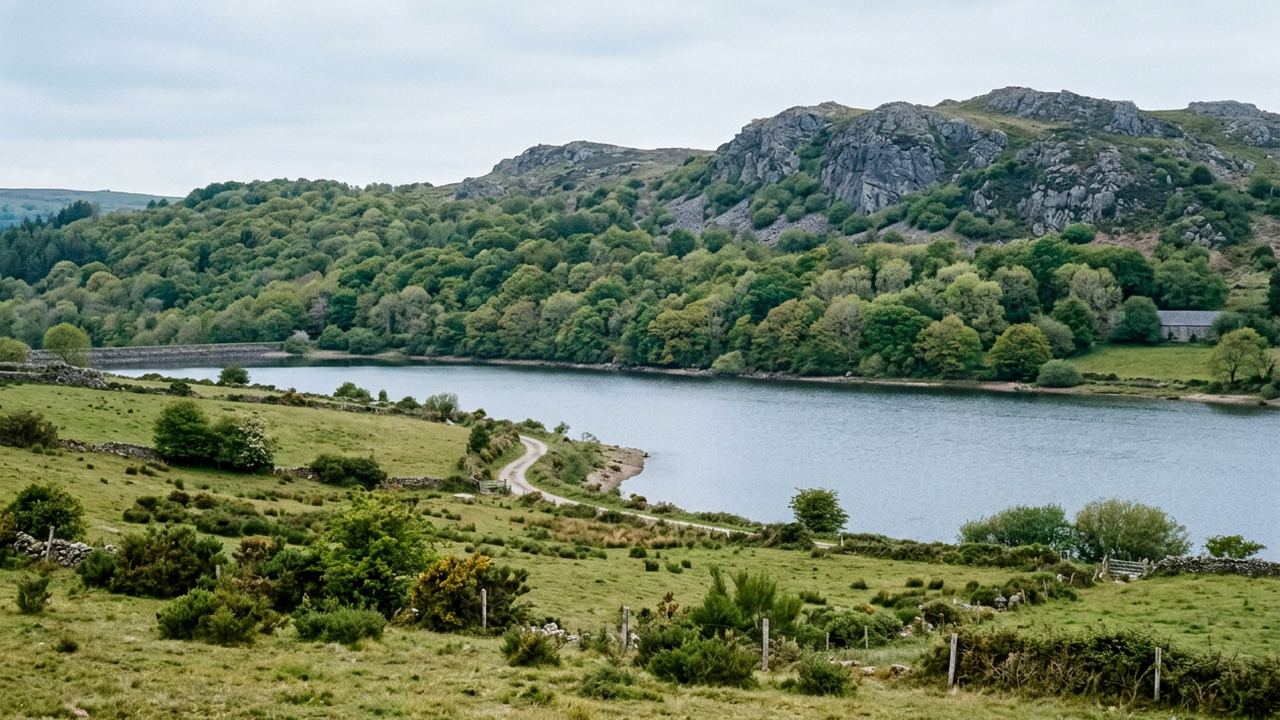
The rock underneath is Hercynian granite, the same old hard stuff as the Massif Central to the south, and it decides the character of every day you spend here. Granite holds water instead of swallowing it. That is why there are peat bogs on the plateau at Saint Brisson, why the reservoirs work at all, and why the paths are soft. Limestone Burgundy, forty miles east, drains overnight after rain. The Morvan does not. Boots that are merely water resistant will be wet by ten in the morning in May, and gaiters are not an eccentricity here.
The forest is roughly half broadleaf and half conifer. The beech is the good part: high canopy, open floor, greenish light, and in the second half of October a color that goes on for three weeks. The Douglas fir blocks came in after the war and are dense, dark and quiet, and some walkers dislike them intensely. You will spend part of most days in each. Between the woods the ground opens to bocage, small pasture fields walled with dry granite and hedged with hawthorn, holding Charolais cattle in numbers. This is the awkward part of the terrain: many marked routes cross grazed fields directly, gates are heavy and wired shut, and cows with calves will follow you across a field at a walk. Nobody in the office will tell you that this is nothing. It is manageable and it is also the single thing first time walkers here comment on.
As a record rather than a forecast, the pattern of recent seasons has been this. Spring has run wet and green with standing water on the plateau into early June. July and August have been warm without the heat that closes the south, typically in the upper seventies with thunder building over the high ground in the late afternoon three or four days a week. September has been the driest and steadiest stretch. October has turned quickly. None of that is a promise about the week you pick, because a season is a record of what happened and not a claim about what will.
The party this week actually works for
This suits two or four people who are comfortable driving themselves, who want the walking to be the day rather than an item in the day, and who are content to eat where they sleep. Because there are three bases of three nights each, you unpack three times in nine nights and you drive between forty and seventy minutes on each moving day. The car is not a luxury. There is no useful public transport inside the park, and the last rail line that would have served you was lifted decades ago.
It suits people who like a place to be flat about itself. There is one Gallo-Roman capital of real consequence here, Bibracte on Mont Beuvray, where the Aedui had an oppidum of maybe twenty thousand people and where Vercingetorix was made commander of the Gaulish coalition in 52 BC. It is a serious site with a serious museum and it is also mostly earthworks under beech trees, which some visitors find quietly astonishing and others find is a hill. We would rather you knew that in advance than discovered it on day five.
The same twenty-four trips are printed in five orders. This one sits in a different place in each, and none of the five positions is a judgement about it.
- Hours in the air
- 5 of 24 at 10 hours. The whole order
- Miles walked a day
- 14 of 24 at 7 miles. The whole order
- Per cent decided in advance
- 4 of 24 at 32 per cent. The whole order
- From, per person
- 16 of 24 at $2,880. The whole order
- Different beds
- 4 of 24 at 3 beds. The whole order
What the seasons have actually done here
- Late April to mid May
- Woods bare at the top and green at the bottom, water everywhere, peat bogs impassable off boardwalk. Roughly half the village restaurants have not opened yet, so dinner choice is thin and driving further is normal.
- Mid May to late June
- The best walking of the year and the fewest people, with long light until half past nine. Ground still soft on north slopes. Cattle go out to pasture, so field crossings begin in earnest.
- July
- Warm, upper seventies, with afternoon thunder building over Mont Beuvray on three or four days in the week. Reservoir swimming becomes genuinely pleasant. French holidays have not started, so villages stay quiet.
- August
- The one busy month, and busy here means the beaches at Lac des Settons and Lac de Pannecière have families on them. Walk half a mile from a parking lot and it empties again. Book dinner or eat late.
- September
- Historically the steadiest stretch: dry ground, cool mornings, cattle still out, every kitchen open. Light shortens noticeably by month end. This is the month we would take ourselves.
- Early to mid October
- The beech color, which has run about three weeks and does not repeat. Mornings near freezing on the plateau. Some hotels shut midweek, so the itinerary tightens.
- Mid October to April
- Closed for this trip. Kitchens shut, several hotels shut entirely, and lanes above 1,800 feet ice at night without being treated.
The thing that costs money and nobody mentions
The rental car deposit. The desk at Lyon will place a hold of around 1,200 euros on a credit card in the driver's name, and it must be a credit card, not a debit card, and the name on it must match the license exactly. That hold sits against your limit for the whole trip and for some days afterward. Parties have been turned away at the counter over a middle initial. This office will tell you the requirement three times before you go, and the third time will feel excessive, and it is still the most common way a French driving week comes apart.
The second is dinner, which is not a cost so much as a limit. Nine nights in villages of a few hundred people means seven of your dinners are at your hotel, cooked by the family that owns it, from a menu of three choices that rotates. It is generally very good, it is Charolais beef and river fish and a great deal of cream, and by the eighth night some people are tired of it. Two dinners are left open on purpose so you can drive to Autun or Château-Chinon and eat something else. If your party cares deeply about variety at the table, this is the week's real weakness, and we would rather name it than let you find it.