People arrive in Latgale expecting a poorer version of the rest of Latvia and find something with a different center of gravity. The signs are bilingual in a way the coast is not. The churches are Catholic, and full on a Sunday morning, in a country whose national story is Lutheran and whose capital is largely neither. Russian is the language you hear in the shop in Karsava, Latvian in the school across the road, and Latgalian, which is either a language or a deep dialect depending on who is arguing, at the kitchen table. None of that is a curiosity laid on for a visitor. It is just the arithmetic of a border region that has been on the wrong side of four different frontiers within living memory.
What the photographs leave out is the water. Latgale has something over two thousand lakes, and the ones that matter to a week here are not scenic viewpoints but working surfaces: someone's nets are in them, someone's cows drink from them, and the road bends because the lake was there first. Razna is the big one, about fifteen square miles, with a shallow warm south shore and a hard blue north end. But the ones you will remember are smaller, unnamed on the road atlas, glimpsed for four seconds through birches at 40 mph. This is a landscape that does not arrange itself for a windshield. You have to stop the car.
The other thing left out is how cheaply you eat. A full lunch in a village canteen, the kind with a steam table and a woman who tells you what to take, is six or seven dollars including the soup. This is not a bargain arranged for anybody. It is the local price, and it holds because local wages hold it there.
- The week in one sentence
- Nine nights in five places: three farm guesthouses, one small hotel above a bakery in Ludza, and one room in a potter's household near Preili, moved between by a hired car you drive yourself, with luggage staying in the trunk between towns.
- Why this and not the next one
- Riga airport is 170 miles west of Ludza, three and a half hours on the A12 with one coffee stop. Ground is glacial: low hills, forty-mile stretches where the road runs between two lakes at once, gravel on perhaps a fifth of the driving. Beds are farm rooms with private bathrooms, one shared kitchen, no elevator anywhere. The season opens in the first days of May and closes midway through October, closing when the guesthouses drain their pipes. Nine nights, from $2,500 per person.
- Inside the figure
- Nine nights of accommodation in five places, two people sharing; a compact hired car with unlimited mileage and Latvian insurance, collected and returned at Riga airport; breakfast at every property; two evening meals at farms that cook when asked; a half day at a working pottery in Silajani or Litaunieki with clay and a wheel to yourself; the entrance fees at Aglona basilica grounds, the Ludza craftsmen's center and the Rezekne regional museum; a printed road book with the roads that are gravel marked in gray; and a Latvian phone number that answers in English during Latvian daytime hours.
- Outside it, and what that runs to
- Flights, which have run $840 to $1,290 round trip from Chicago or Minneapolis by way of Frankfurt, Helsinki or Warsaw; fuel, roughly $95 for the whole nine nights at Latvian pump prices; the seven lunches and seven dinners you buy yourself, which in Latgale run $6 to $14 a head and are the reason people come back; the car's fuel deposit of about $75, refunded; parking in Riga if you keep the car there, $18 a day; the boat hire at Razna, $12 an hour; anything you buy from the potters, where a fired dish runs $15 to $60; and travel insurance, which this office does not sell or advise on.
- Reasons to book something else
- Do not reserve this if you will not drive. There is no other way to move: the rural bus between Ludza and Karsava runs twice a day and not on Sundays, and taxis outside Rezekne are a phone call and a forty minute wait. Expect to drive 40 to 70 miles most days, some of it on washboard gravel at 25 mph, and to park on grass. Also skip it if you need a restaurant open past nine, an elevator, or a room where nobody knocks to offer you food.
Glacier left the hills, the border left the churches
The ground under this trip was shoved into place by ice. The Latgale upland is a set of low moraine hills, none of them over 950 feet, with meltwater lakes filling every hollow between. The practical consequence for a driver is that no road here goes straight for long, and the eleven miles between two villages on the map is fourteen on the odometer and thirty five minutes on the clock. Distances in Latgale should be read in minutes, never in miles.
On the record, the season behaves like this. May opens cold and bright, with the birches coming out in the second week and night temperatures still touching the mid thirties. June and July have run warm, high seventies in the day, with afternoon thunderstorms that come and go inside two hours. August is the warmest water and the most mosquitoes near the lakes at dusk. September has been the steadiest stretch in the last decade of records, dry days in the low sixties, and it is when the light does the thing everybody photographs. This is a record of what those weeks have been, not a claim about the weeks you have chosen. Pack for a forty degree swing in a day and you will be right most of the time.
A day here has a shape it is worth knowing before you commit. Breakfast is at eight and it is enormous. Anything you want to visit, a pottery, a church, a museum, is open from ten to five and shut for lunch somewhere in the middle. The shop in a village of two hundred closes at six. Dinner, if you did not arrange it with the farm in the morning, is a real problem after eight in the evening outside Rezekne and Daugavpils. The rhythm is agricultural, and a week here goes much better when you stop fighting it around the third day.
Who gets on well here, and who spends the week annoyed
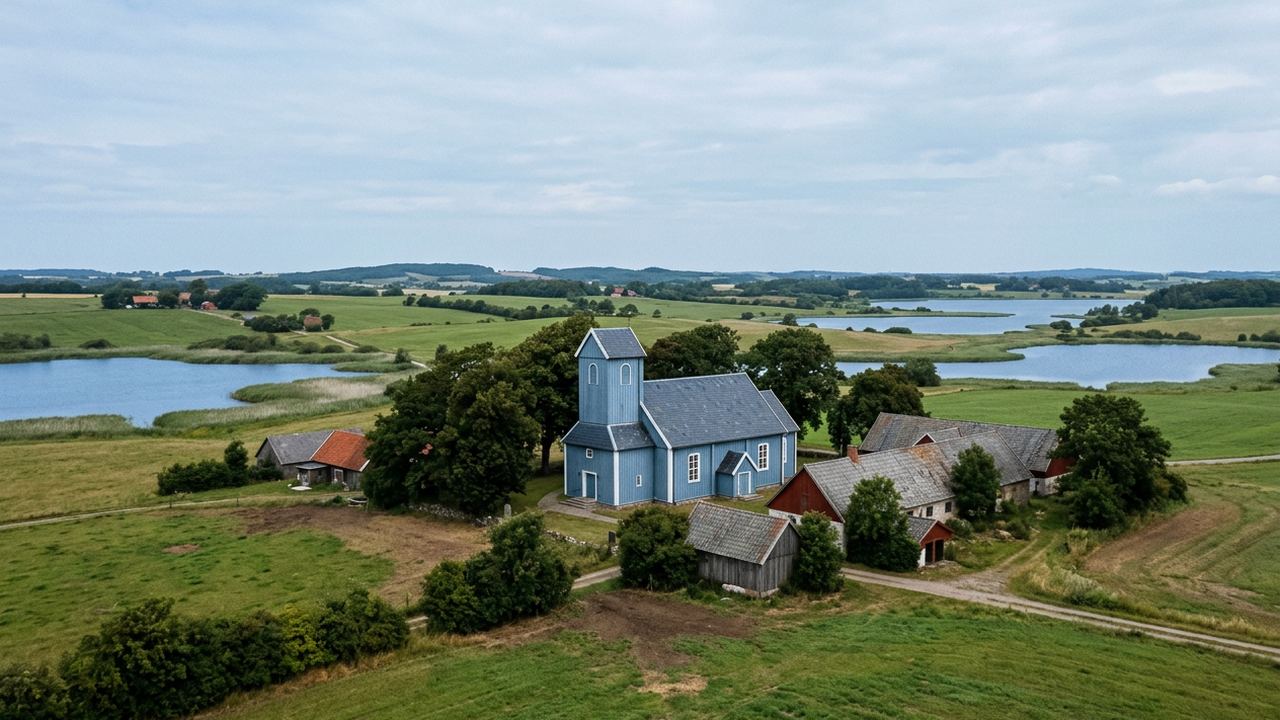
This suits people who are content to be the only visitor in the room and who do not need to be told what they are looking at. Nothing in Latgale is interpreted for you. The blue wooden church at the end of a farm track has no panel explaining itself, no ticket desk and often no lock, and if a woman is inside changing the flowers she will nod and carry on. The potters at Silajani work in sheds behind their houses and will let you watch for as long as you like, but they are not performing, and the conversation happens in fragments through whatever language you have between you. If that sounds thin rather than rich, this is the wrong week.
It also suits people who like a car and a map and no plan. Roughly seventy percent of your waking hours here are unallocated, which is the highest proportion of any trip this office arranges. That is a decision, not an oversight. The five things we have booked are booked because they need arranging in advance: the beds, the car, two farm dinners, the pottery half day, and one boat. Everything else you find by turning off the road, and the people who enjoy this trip most are the ones who treat that as the point.
The same twenty-four trips are printed in five orders. This one sits in a different place in each, and none of the five positions is a judgement about it.
- Hours in the air
- 12 of 24 at 12 hours. The whole order
- Miles walked a day
- 2 of 24 at 4 miles. The whole order
- Per cent decided in advance
- 2 of 24 at 30 per cent. The whole order
- From, per person
- 9 of 24 at $2,500. The whole order
- Different beds
- 19 of 24 at 5 beds. The whole order
What each stretch of the open season has actually been like
- Early May to the end of May
- Birches in leaf by the second week, nights near 38 degrees, lakes too cold to swim. Guesthouses just reopened, so you are often the only guests. The season low on beds, and the fewest insects.
- June
- Long light, dark only after eleven at night. Warm afternoons in the mid seventies broken by short thunderstorms. Midsummer week around June 23 fills every farm room in the region, so it is booked eleven months out or skipped.
- July
- Warmest water at Razna, upper sixties, and the busiest the region ever gets, which still means a shore with four other families on it. Village canteens keep their fullest hours. Bring repellent for dusk.
- August
- The pottery kilns fire hardest before the autumn markets, so this is the best chance to watch a firing rather than a demonstration. Mushrooms start in the last week, and every second car on a forest road is somebody's grandmother parked in the ditch.
- September
- The steadiest stretch on record: dry days in the low sixties, cold mornings, no insects, low light through birch and pine all afternoon. Rooms cost about what they do in May and the roads are empty.
- Early to mid October
- Color peaks in the first ten days, then the rain sets in and the gravel roads soften. Guesthouses begin closing without much warning around the fifteenth, and the season ends when the pipes are drained, not on a fixed date.
The border, the gravel and the ninety minutes nobody warns you about
Here is the awkward part. Latgale's eastern edge is the external border of the European Union, and the roads that look like the obvious shortcut on a map, the ones running east of Karsava or south of Zilupe, end at a frontier you cannot cross without documents this office does not sell or advise on. There is also a border zone within which stopping and wandering off the road is restricted. It is signposted, and the signs are not in English. Your road book marks the whole strip in gray, and the rule we give people is simple: if the road is heading east and the villages are getting smaller, turn around. Nobody has had trouble, but nobody should be casual about it either.
The second awkward thing is the driving. About a fifth of the mileage on this itinerary is gravel, and Latvian gravel in dry August is washboard that rattles the mirrors at anything over 30 mph, while the same road after two days of October rain is a slick clay surface where a small front wheel drive car will slide on a gentle bend. The hired car is a compact, not an SUV, because an SUV would double the price of the week and would still be a car with ordinary tires. Budget ninety minutes for what looks like a forty minute drive, and do the long transfer to Ludza in daylight on your first day, when you are still adjusting and still counting in the wrong units. Two things to say plainly: elk and boar are on these roads at dawn and dusk in real numbers, and there is no roadside assistance that will reach you inside an hour in the eastern parishes. The car comes with a Latvian breakdown number in the glovebox and a person at the end of it, which is the honest limit of what anyone can promise.