The photographs of Jeju are almost always taken from the water or from the air, which makes it look like an island of cliffs and one cone. On foot it is mostly farmland. You walk past tangerine groves behind stone walls for an hour at a time, then a stretch of greenhouse plastic, then a village of forty houses where the route is marked by a blue and orange ribbon tied to a fence post. The dramatic stuff is real and it is roughly one hour in every six.
The second thing people get wrong is the walls. They are everywhere, thousands of miles of them, stacked dry from the same black volcanic rock the whole island is made of, and they are not decoration. They mark field boundaries and they break the wind, which on the exposed south coast is the single fact that shapes your day. Nobody photographs a wall. You will spend nine days beside them.
Third: the coastal route is numbered, and the numbers matter more than the names. Sections run from one upward around the island, each with a start point, an end point and a stamp box. Walkers talk in numbers. When you tell a guesthouse owner you finished twelve, they know exactly where you were at four in the afternoon and how tired you are. This trip covers seven of them, in order, on the south and east sides.
- The week in one sentence
- Nine nights: seven in family run guesthouses of four to nine rooms along the coastal route, two in a small hotel near the island's main town, moved by a booked driver and one local bus, with a bag transfer van carrying everything but a daypack between each night.
- Why this and not the next one
- Jeju is a two hour hop from Seoul Incheon, and the flight in from the American middle is fifteen hours in the air across two segments, so the first day is lost. The walking surface is the argument for it: black basalt shelf, packed sand, forest track and long stretches of paved village lane, almost never technical, almost never quiet underfoot. Beds are eight by ten foot guest rooms with a shared kitchen. The season runs late March to mid June and again late September to early December. From $2,490 per person.
- Inside the figure
- Nine nights of accommodation with private rooms and shared bathrooms in four of them; breakfast every morning; daily bag transfer between guesthouses; airport transfers at both ends; a booked driver for the two inland days; entry to the lava tube open to visitors and to the folk village; a printed set of section notes with water points and bus stops marked; the reservation itself placed with the operating company and confirmed to you in writing.
- Outside it, and what that runs to
- International and domestic airfare, usually $1,150 to $1,700 round trip from Chicago or Dallas depending on the month; lunches and dinners, which run $9 to $22 a head at village restaurants and roadside noodle houses; the $12 to $18 taxi fares you will want on two afternoons when a section overruns; the mountain permit and shuttle if you climb it, about $30 with the reserved time slot; travel insurance, which this office does not sell or advise on; entry documents of any kind, which this desk neither sells nor comments on; alcohol; tips, which are not customary here but which some drivers now expect from foreigners.
- Reasons to book something else
- Do not reserve this if you cannot walk nine miles a day, seven days out of nine, on hard surfaces. About four of those miles each day are paved lane and basalt shelf, and the shelf is uneven black rock that turns ankles. There is climbing only on the inland days, 1,300 to 2,600 feet, but the flat days punish knees and feet harder than a mountain would. Guesthouse rooms are small, walls are thin, and four of the nine nights share a bathroom with two other rooms. Anyone needing an elevator, a private bath every night or a rest day should look at a different trip.
What the basalt does to a walking day
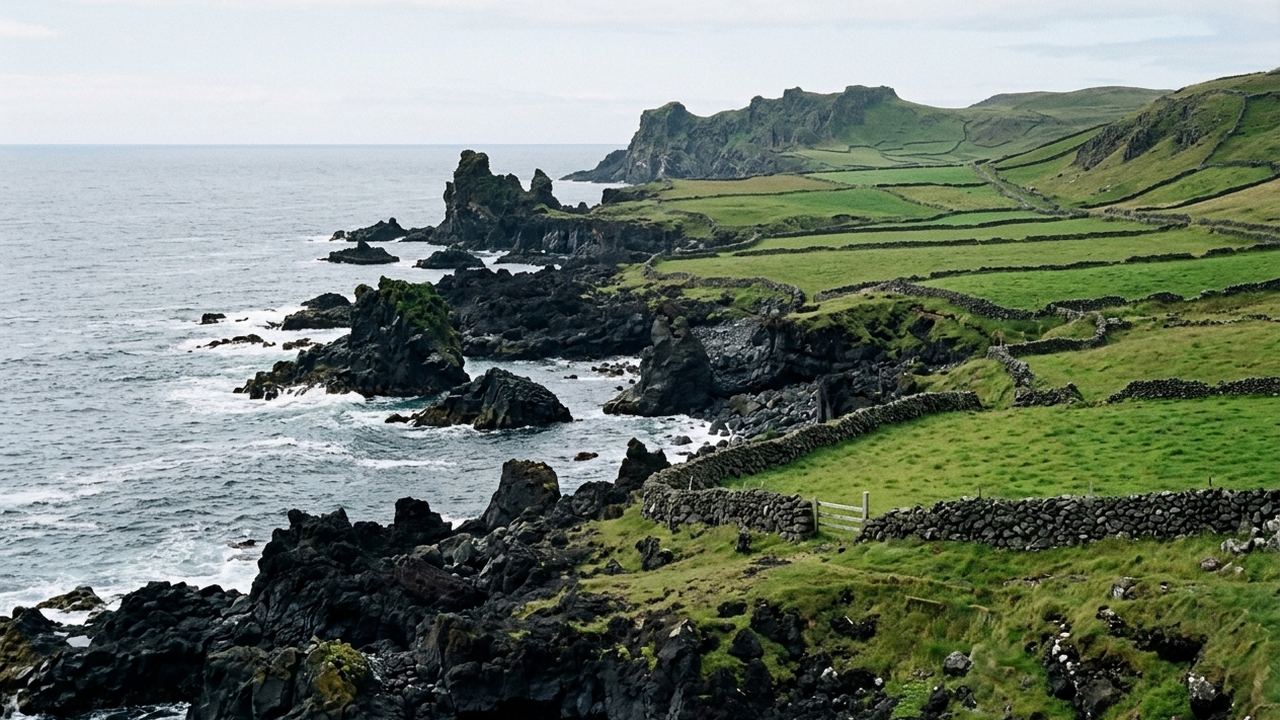
The surface changes character four or five times between breakfast and the last mile, and none of the changes are gradual. Packed coastal sand for twenty minutes, then a mile of shelf where the lava ran into the sea and cooled in ridges, then paved lane through a village, then a forest path of pine needles over volcanic grit. The shelf is the part that decides how you feel at six in the evening. It is black, it is porous, it grips a boot sole well in the dry and it holds standing water in every hollow after rain.
The weather record for the walking months is mild and wet in a specific pattern. Late March through May has run in the high fifties to low seventies Fahrenheit, with rain arriving in fronts that pass in half a day rather than settling in. June brings the rainy stretch, which is why the spring season closes in the middle of that month. Autumn from late September has run warmer than spring, low seventies falling into the low sixties by November, and drier. Winter on the coast has stayed above freezing in most years, which is unusual at this latitude and is the reason the tangerines grow, but the interior and the mountain hold snow from December.
Wind is the number the record shows most clearly and the one people plan for least. The south and west shores take it from the open sea, and a fifteen mile an hour headwind on an exposed shelf section adds something like ninety minutes to a nine mile day. Two of the seven sections on this route face that way. The bag transfer is not a luxury on those two days; it is the reason they finish before dark.
The kind of walker this route rewards
This suits someone who wants to walk every day without carrying anything, who is content to eat what the village restaurant is cooking, and who does not need scenery to be continuous. If you need every hour to be worth a photograph you will be disappointed by hours two through five. If you like the rhythm of covering ground on foot and arriving somewhere by your own effort, this is one of the easier places on earth to do it: the route is marked, the ribbons are frequent, the buses run, and you are never more than a few miles from a road.
It also suits people who want a walking trip without altitude. The whole coastal circuit stays near sea level. The only climbing is the two inland days, and one of those is optional. Compare that to a mountain route where every day is a thousand feet up and a thousand down, and the difference in what your legs feel by night five is substantial.
The same twenty-four trips are printed in five orders. This one sits in a different place in each, and none of the five positions is a judgement about it.
- Hours in the air
- 20 of 24 at 15 hours. The whole order
- Miles walked a day
- 22 of 24 at 9 miles. The whole order
- Per cent decided in advance
- 10 of 24 at 45 per cent. The whole order
- From, per person
- 8 of 24 at $2,490. The whole order
- Different beds
- 23 of 24 at 8 beds. The whole order
Nine seasons of record on the south coast
- Late March to mid April
- Cold wind off the water, high fifties by afternoon, rapeseed in flower along the field walls. Guesthouses are half empty and owners have time to talk. Some coastal restaurants have not opened for the year.
- Late April to late May
- The best surface of the year: dry shelf, firm sand, high sixties. Also the busiest stretch on the route itself, particularly on weekends when domestic walkers arrive by the busload for a single section.
- Late May to mid June
- Warm, low seventies, humidity rising sharply. Rain becomes frequent rather than occasional. Section pace drops by roughly a mile an hour on wet basalt and the last hour is often done in drizzle.
- Mid June to late August
- The rainy stretch and then heat with high humidity, upper eighties. This trip does not run then. Walkers who go anyway generally cover half a section a day and start before six.
- Late September to late October
- Warm and dry, low to mid seventies, the clearest air of the year. Tangerines are green on the trees. Accommodation costs about fifteen percent more and books out four to six weeks ahead.
- Early to late November
- Falling into the low sixties, tangerine harvest underway, groves full of people and ladders. Wind picks up in the second half of the month. Fewer walkers, easier beds, shorter daylight by roughly ninety minutes than in May.
- Early December
- High forties to mid fifties on the coast, snow beginning in the interior. The last week this trip runs. Some guesthouses close for the winter without warning, which is why the office confirms each bed twice.
The women divers, and why we do not put them on the itinerary
You will see the haenyeo, the women who free dive for shellfish and sea urchin without air, if you walk the east coast sections in the morning. There are orange floats offshore and a low concrete shelter where they change. What you will not get, and what several visitors expect because a documentary told them otherwise, is a scheduled diving demonstration on the day you happen to be there. They work when the tide, the sea state and their own bodies allow it. Most of them are over sixty five and the number of active divers has fallen by roughly ninety percent since the nineteen sixties. There is a museum on the north east coast that explains the work honestly, and there are villages where you can buy what came up that morning and eat it thirty feet from the water, and both of those are real. A performance is not.
The awkward part of this trip is the interior. Getting from the coast to the mountain and the tube country without a car is genuinely tedious: the bus network runs around the ring road far better than it runs across the middle, and a journey of eighteen miles inland can take ninety minutes with a change. That is why two days of this trip come with a booked driver, and it is a meaningful share of the price. The main summit route also runs on a reserved time slot system with a daily cap, which the office cannot influence and cannot bypass, and which must be secured by you at the time it opens. We will tell you when that is and what the website looks like. We will not pretend to hold a slot we do not hold.
What this office will and will not tell you about the five orders
This trip sits somewhere in the middle of every one of the five orders on this site, and that is a fact about the trip, not a compliment to it. Nine nights is neither short nor long. Fifteen hours in the air is a long way for a walking holiday and there is no honest way around that number. Nine miles a day is moderate by walking standards and hard by everyone else's. Forty five percent arranged means your beds and your bags are settled and your daylight is not.
Which of those five numbers should decide your year is not a question this office answers. Sort the catalogue by flying time and this trip falls a long way down. Sort it by cost per night on the ground and it rises. Both sorts are correct, and we publish no opinions and grade nothing. Amber Almanac takes the request, places the reservation with whoever runs the trip, and is paid by that firm once you are back. The request form runs around the clock and never closes; whatever arrives is opened by somebody at this desk before that working day is out, and a written figure priced against your particular dates sits with two operating firms for two to four working days first.