The photographs almost always show the same thing: a row of weathered poles leaning at a village site, moss to the waterline, nobody in the frame. What the frame leaves out is how you got there. You got there in a small aluminum boat that left at six in the morning because that was the only window in the tide and the wind, you sat for three hours in spray, and you arrived at a place where a Haida watchman lives for the season and decides how many people walk up the beach and where they stand. The poles are falling down on purpose. Nobody props them. That is the whole point and it surprises people who expected a maintained site.
The second thing people get wrong is scale. This is not one island you can drive around in a morning. Graham Island alone runs about sixty miles from Skidegate up to Masset on one road, and that road is the only road. Moresby, the southern island, has almost no road at all past Sandspit, and the part everyone wants to see, Gwaii Haanas, has no road, no dock, no store and no cell signal. You reach it by boat or float plane and you reach it on someone else's schedule.
And the third: distance. From the middle of the United States this is a full travel day each way, sometimes two. Denver or Chicago to Vancouver, then a connection to Sandspit or Masset that runs on a small aircraft and cancels for fog more often than anyone tells you, or Vancouver to Prince Rupert and then eight hours on an overnight ferry across Hecate Strait. Hecate Strait is shallow and it stands up fast. We build the itinerary around the ferry because it is the more reliable of the two, which tells you something about the plane.
- The week in one sentence
- Nine nights: two in Skidegate, three in Port Clements or Tlell, two on Moresby near Sandspit, two back at the north end, moved by rental vehicle and one inter island ferry, with your bags going wherever you go because nothing is portered.
- Why this and not the next one
- Sandspit and Masset take two connecting flights from the middle of the country, roughly seven hours in the air plus a long wait in Vancouver, or an eight hour overnight sailing from Prince Rupert. The ground is logging road, beach gravel and root, wet most days. Beds are small inns, a lodge and one guesthouse, none of them large. The season we work runs from the second week of May to the last week of September. Nine nights, from $3,940 per person.
- Inside the figure
- Nine nights lodging in a mix of inn, lodge and guesthouse rooms; the overnight ferry crossing from Prince Rupert with a cabin; the inter island ferry to Moresby; a mid size rental vehicle for the full stay with the local insurance the agency requires; two full day boat charters to watchman village sites with the Haida Gwaii Watchmen fee paid; breakfast at every property; the tide dependent scheduling work, which is real work; and the written itinerary with the operator's own contacts on it.
- Outside it, and what that runs to
- Flights to Prince Rupert or Sandspit, which have run $680 to $1,150 round trip from Chicago or Denver depending on how early you commit; fuel, and the island runs roughly a dollar a liter above Vancouver; every lunch and dinner, and there are stretches of road with nothing open, so figure $70 a day per person and carry food; the $30 Haida Gwaii Pledge fee if it is not bundled by your operator that season; laundry, which you will want by night five; a dry bag and real rain shell, $150 to $300 if you own neither; and any night you get stuck on the wrong side of a canceled sailing, which is on you and runs $140 to $220 for a room in Prince Rupert.
- Reasons to book something else
- Do not reserve this if a canceled boat ruins your week. Two of the nine days are weather held and one of them will probably move. The village landings mean a small boat in open water for two to five hours, then a wet ladder or a beach step off into shin deep cold water, then a mile to two miles on soft ground and slick root with no handrails and no bathroom. If you cannot get in and out of a rocking boat unassisted, or you need a firm schedule to sleep at night, this one will make you unhappy and we would rather say so now.
Rain, root and the eight hours of daylight you actually use
The record for this archipelago is wet and mild rather than cold. Coastal stations here have logged something on the order of fifty to sixty inches a year on the east side and considerably more on the windward slopes, spread across most months rather than dumped in one. Summer daytime temperatures sit in the high fifties and low sixties Fahrenheit and rarely break seventy five. What that has meant in practice, from what operators here report back season after season, is that a dry week is not the good outcome to hope for. A week with three usable boat days is the good outcome.
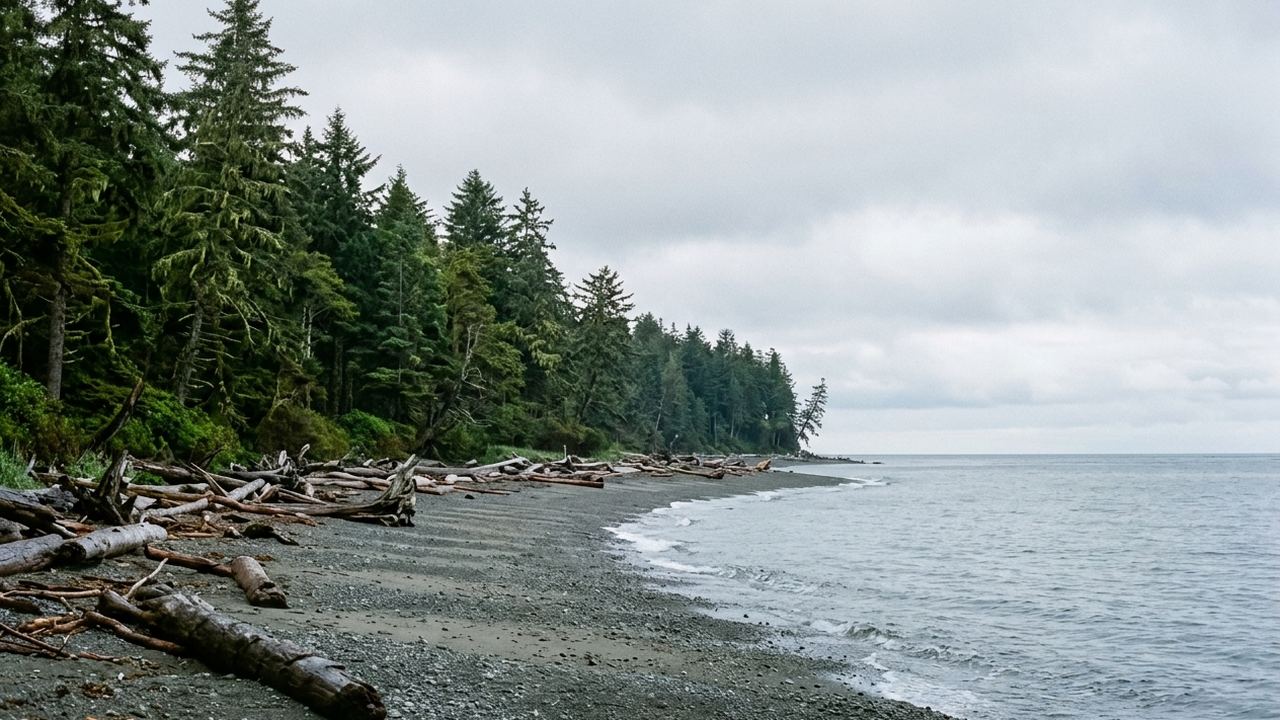
A day on the ground looks like this. You are up early because the boat days are early. On a village landing day you are moving from six until four or five with a packed lunch and no store. On a non boat day you might walk two to four miles: the Spirit Lake trails near Skidegate, the beach at Tlell where the shipwreck sits in the sand, the boardwalk sections in Naikoon, or the north beach out past Masset where the driftwood is stacked twelve feet high. None of it is technical. All of it is slick. Root, boardwalk with algae on it, and beach cobble that rolls.
We say the ground is wet rather than saying you should pack rain gear, because the difference matters. It is not that it rains and then stops. It is that the forest floor holds water constantly, so the moss is saturated, the logs are greased, and boots that are merely water resistant are wet through by noon on day two. People who bring one pair of shoes have a bad week.
The kind of traveler who comes back happy from here
The people who do well on this trip are the ones who wanted the archipelago specifically, not a general idea of wilderness. If you can name why you want to see a Haida village site rather than a national park, you will be fine. The trip also suits people who are comfortable with a rental car and a paper map, because there is a long stretch of the island road with no signal and the local businesses are small enough that they close when the owner has something else to do.
It suits people with about half a plan. Forty five percent of your waking hours are fixed before you land: the two boat days, the ferry sailings, the check in times. The rest is yours and you will need to fill it yourself. There is no desk in the lobby arranging things for you, because most of these properties do not have a lobby.
The same twenty-four trips are printed in five orders. This one sits in a different place in each, and none of the five positions is a judgement about it.
- Hours in the air
- 4 of 24 at 7 hours. The whole order
- Miles walked a day
- 1 of 24 at 4 miles. The whole order
- Per cent decided in advance
- 9 of 24 at 45 per cent. The whole order
- From, per person
- 24 of 24 at $3,940. The whole order
- Different beds
- 15 of 24 at 4 beds. The whole order
What the last several seasons have actually done, May to October
- Early to mid May
- Fewest people and the season low on rooms, but several operators are still bringing boats out of winter storage and some watchman sites are not staffed yet. Cold rain, mid forties at night.
- Late May to mid June
- The stretch we book most. Watchman sites staffed, seabirds thick on the cliffs, long light until nearly ten at night. Wind still cancels roughly one boat day in four.
- Late June through July
- Warmest and driest of the year in the record, sixties most days, and the busiest. Rooms in Skidegate and Queen Charlotte fill four to six months out and cost the most. Book far ahead or take Port Clements.
- August
- Still settled, still busy, and the salmon are moving, which means bears on the rivers and roadside. Wind picks up in the last ten days most years. Prices ease slightly after the twentieth.
- September
- Our quiet favorite. Fewer people, rooms drop, color comes into the alder, and the strait gets serious. Expect one to two full weather days out of nine and expect to use them.
- Late September to early October
- Watchman sites begin closing for the season, some in the last week of September. Storms come through in real sequence now, sixty mile an hour gusts on the outer coast. We stop selling this trip after the first weekend of October.
The two things about this trip that make people angry afterward
The expensive part is not the lodging. It is the boat. A full day charter out to a watchman village site with fuel, a licensed operator and the Watchmen fee runs a large share of what you are paying, and it runs whether four people or ten are aboard. Two of those days is why nine nights here costs $3,940 rather than half that. People look at the room rates on the island, do the arithmetic, and write to ask why the figure is what it is. That is the answer, and we would rather put it in writing now than defend it later.
The awkward part is cancellation. If the wind stands up on your boat day, the day does not happen, and the operator moves it if there is another day to move it to. Sometimes there is not. In a nine night stay with two charters we hold two spare days for exactly this, and most seasons that is enough. Some years it is not, and a party goes home having seen one village site instead of two, or none. The operator's own refund terms govern what happens to the money in that case and we put those terms in front of you in writing before you commit, because they vary and some of them are not generous. We do not take your payment, we do not hold your card, and we cannot overrule an operator on a refund. What we can do is tell you which operators have been straight about it.
One more piece of honesty. This office does not sell or advise on travel insurance, and crossing an international border is your own business to arrange: we do not handle entry documents and will not guess at them for you. We book the trip. If you want a written figure priced against particular dates, send the form and give us two to four working days.