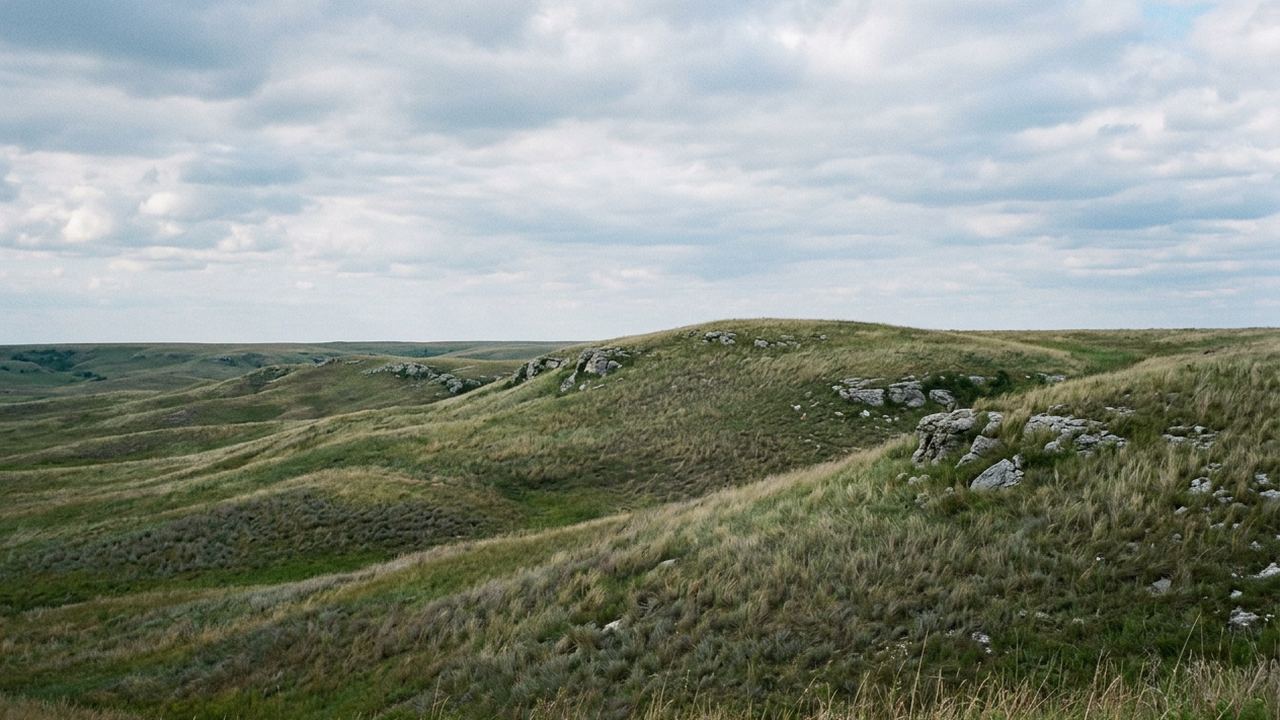
The photographs get the sky right and the ground wrong. What a wide lens does to the Flint Hills is flatten them into a green table, when in fact the whole thing is a staircase: bands of limestone and shale laid down in a shallow sea, weathered back at different rates, so every hillside steps up in benches you can count from the road. Stand on one and you see the same three or four steps repeating across four miles of the next ridge. That structure is also the reason there is anything left to look at. The rock sits inches under the topsoil, plows broke on it through the whole of the 1870s and 1880s, and so about four percent of the original tallgrass prairie survived here while the rest of it went to corn and soybeans from Illinois to Nebraska.
The second thing photographs leave out is that this is not a park with cattle in it. It is a cattle operation with a park inside it. Roughly the entire landscape you drive through is privately owned working range, stocked in April with yearlings shipped up from Texas and Oklahoma, pulled off in July or held to fall depending on the grass and the market. The burning that makes the spring photographs so dramatic is not a spectacle. It is a range management practice with an economic argument behind it, done in a two or three week window in late March and April, and it produces smoke that closes highways and grounds small aircraft. Visitors sometimes arrive expecting to be told where to walk. Outside the preserve and a handful of public tracts, the honest answer is that you walk where a rancher has said you may walk, which is why this trip is built around four hosts who have said so in writing.
Third: the grass is genuinely tall, but only later than most people come. In May it is ankle to shin. Big bluestem reaches its full seven or eight feet by September, when the color turns copper and the tourist traffic has gone home. People who come in May for tall grass are looking at next year's photographs.
- The week in one sentence
- Eight nights in four beds: three in a ranch guest house near Cassoday, two above a main street storefront in Cottonwood Falls, two in a converted stone schoolhouse west of Council Grove, one final night in Manhattan; one rented car throughout, luggage stays in the trunk between moves.
- Why this and not the next one
- This is a driving trip and there is no flight to price. From Lincoln it is 240 miles to the first bed, roughly four hours with one stop, and you will put 700 to 900 miles on the car over the week. The ground is chert gravel over limestone bench, hard on tires and quiet under boots. Beds are ranch guest rooms, a storefront apartment and a stone schoolhouse, all with private baths. The season the office books runs mid April to mid October. From $2,520 per person, two sharing.
- Inside the figure
- Eight nights of lodging in four separate places, all private bath; midsize rental car with unlimited mileage collected and returned in Lincoln; two half day rides with a working cattle outfit, saddle and horse provided; a guided walk on the tallgrass preserve with a prairie ecologist; entry to the preserve, the county historical rooms in Cottonwood Falls and the Kaw heritage site at Council Grove; eight breakfasts at the lodgings; three ranch suppers cooked by the host families; a printed route packet with gate codes, cattle guard warnings and the phone numbers of every host.
- Outside it, and what that runs to
- Fuel, roughly $110 to $150 for the week at current Kansas prices; the rental car deposit, held at $200 against gravel damage and released after inspection; five suppers and all lunches, figure $18 to $34 a head in the small towns and there are stretches of 40 miles with nothing open; alcohol anywhere, since two of the four counties still run dry on Sundays; laundry, since only the Manhattan bed has a machine; tips to the ranch hands, customarily $20 a person a ride; travel insurance, which this office does not sell or advise on; anything you break on a gate.
- Reasons to book something else
- Do not reserve this if you cannot get in and out of a truck cab unassisted or spend two hours in a saddle: the rides cover six to nine miles at a walk and there is no vehicle following. Average walking is five miles a day over uneven limestone with loose chert underfoot and no shade for the last three of them. July afternoons have hit 101 degrees with the humidity of a river bottom. Nearest hospital to the Cassoday bed is 38 miles. Anyone needing a paved surface, a scheduled day, or a restaurant after 8pm should choose something else.
What the limestone bench does to a walking day
The walking here is not hard by elevation. The relief between a creek bottom and a ridgetop runs 200 to 300 feet and you gain it in stages. What makes a five mile day feel like eight is the surface. Chert gravel weathered out of the limestone lies loose on the benches, roughly the size and hardness of broken crockery, and it turns underfoot. Thin soles are a mistake. So is anything with a mesh upper, because the same chert cuts. Every host on this route keeps a bucket of Vetrap in the barn for exactly this reason and it is mostly used on people.
Shade is the other constraint, and the number worth holding onto is that a burned pasture in late April has none at all. Trees in the Flint Hills survive in the draws and along the creeks because fire never reaches them there. On the open bench there is nothing taller than the grass, which in early season is nothing taller than your boot. Between roughly eleven and four in June, July and August you are standing in full sun with no interruption, and the record for those months shows afternoon highs between the middle eighties and low hundreds with dew points that rarely drop below 65. The office plans walking days to start at first light for that reason, and the ranch rides are booked as morning rides, not because anyone is precious about it but because the horses will not work well past mid morning in August either.
Wind is a permanent condition rather than a weather event. The record for this stretch of Kansas shows a daily average around 12 miles an hour with sustained afternoon periods well above that, and it is the reason the heat is survivable and also the reason conversation on a ridgetop is difficult. Hat with a chin strap or no hat.
Who tends to be glad they came here
The people this suits are the ones who already know that scenery and interest are different things. There is no vertical relief to speak of, no famous rock, no water worth swimming in, and the town at the center of the trip has fewer than 900 residents. What there is instead is a landscape that rewards being read: the burn scars from three weeks ago, the stone fence posts standing where there was no timber to make wooden ones, a stock pond dug in 1954 and the shale ledge that made it hold. If a rancher explaining why he stocks intensively for 90 days rather than lightly for 180 is the best hour of your week, this is your trip. If it sounds like an hour to endure, book something with mountains in it.
It also suits people who want to drive. Eight nights and four beds means you are on gravel county roads for parts of most days, some of it single lane with blind rises, all of it beautiful in the specific way that a road going somewhere useful is beautiful. Two hosts have gates you open and close yourself. That is the trip.
The same twenty-four trips are printed in five orders. This one sits in a different place in each, and none of the five positions is a judgement about it.
- Hours in the air
- 1 of 24 at no flight. The whole order
- Miles walked a day
- 7 of 24 at 5 miles. The whole order
- Per cent decided in advance
- 14 of 24 at 50 per cent. The whole order
- From, per person
- 10 of 24 at $2,520. The whole order
- Different beds
- 14 of 24 at 4 beds. The whole order
Eight seasons the record shows, and what each one costs you
- Mid April to early May
- Burning season tapering off. Blackened ground, first green pushing through, and smoke that has closed I-35 in some years. Cool, 60s to low 70s. The season low on lodging and the fewest other cars.
- Mid May to mid June
- The green flush, wildflowers heaviest, grass still only shin high. Thunderstorms build most afternoons and the record shows this stretch as the wettest, around 5 inches a month. Gravel roads go greasy.
- Late June to mid July
- Cattle are on grass and the rides are at their best. Highs mid 80s to mid 90s, dew points near 70. Chiggers arrive in force. Walking must finish by 10am.
- Late July through August
- The hard stretch. Highs have reached 101 to 106 in the worst years, grass goes dormant and dull, and some yearlings have already shipped. The office discourages this window and prices it lowest for a reason.
- Early September to early October
- The best two weeks most years. Big bluestem at full height and turning copper, highs in the 70s and 80s, humidity broken, and hunting season not yet crowding the lodgings.
- Mid October to early November
- Grass fully cured, gold to rust, light long all day. Cold snaps arrive without warning and one host closes the schoolhouse when overnight lows go under 25. Rides become weather dependent.
- Mid November to early April
- The office does not book this trip. Ranch guest rooms shut, roads glaze, and there is nothing running for a visitor to see.
The forty miles with nothing open, and the gate you have to close
The genuine annoyance of this trip is food. Between the Cassoday bed and the Council Grove bed there is a stretch where the only reliable meal is a gas station counter, and even the towns that have a place to eat mostly have one place, closing at 8pm and shut Sundays and Mondays. Three suppers are cooked for you by the host families and are the best food of the week. The other five you arrange yourself, and the office tells people plainly to buy a cooler in Emporia on day two and keep it stocked. Guests who assume a small Kansas town will produce dinner at 8:30 on a Sunday have gone to bed hungry, and that has happened more than once.
The second thing is livestock gates and the responsibility attached to them. Two of the four properties on this route are reached by a private drive with a wire gate, and leaving one open is not a minor discourtesy. Yearlings get onto a county road, someone hits one at 60 miles an hour, and the rancher is out $1,400 an animal before anyone has called about the truck. Every guest gets the rule in the route packet and in person: the gate goes back exactly as you found it, open or closed. This office takes booking requests and places the reservation with the ranches and the outfit that run the trip; it does not operate any part of it, and the hosts set their own terms about access. That is worth understanding before you reserve rather than after.