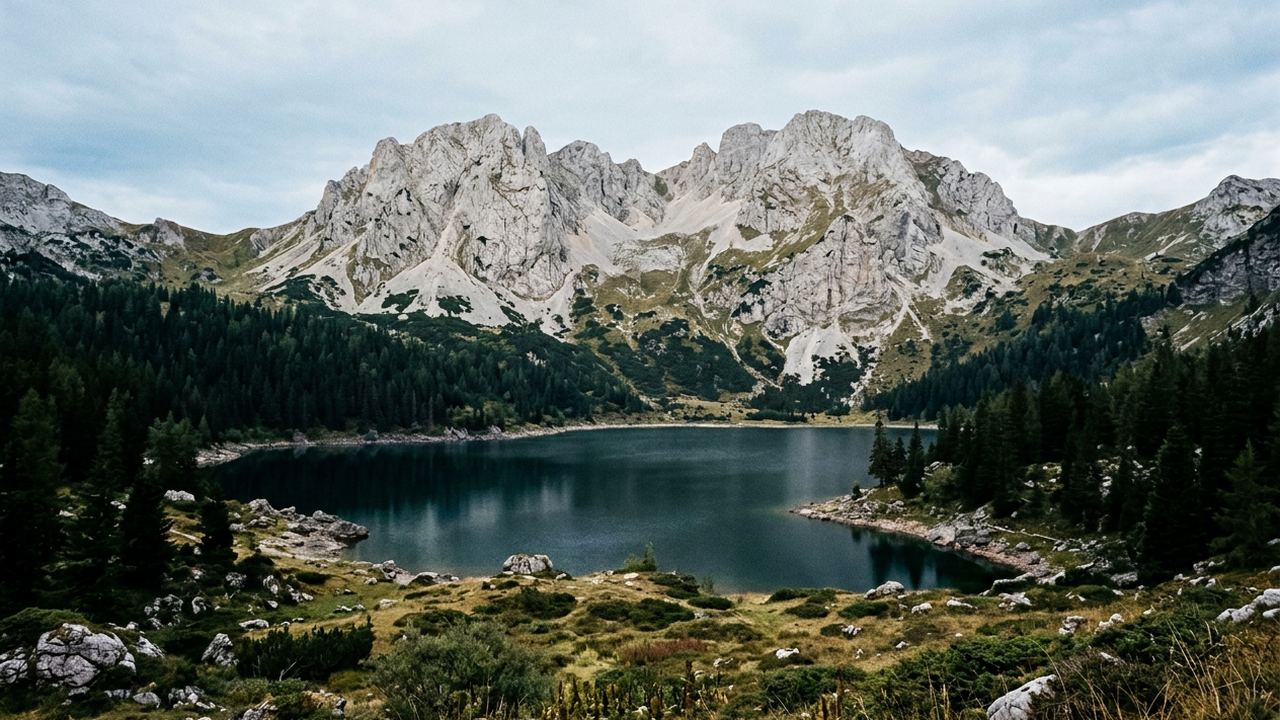
People arrive with one photograph in mind, the dark green lake ringed by pine with a peak behind it, and they are usually surprised twice in the first two days. The first surprise is that the lake is small, about half a mile long, and busy: it is fifteen minutes from town on a paved path, there is a cafe, and on an August afternoon there are families with strollers on the loop. It is a pleasant hour and it is not the reason to come.
The second surprise is what lies behind it. Walk past the far end of the lake and up through the pine for ninety minutes and the trees stop, more or less all at once, and the massif opens into a series of stone bowls with almost nothing living in them. That is the actual place. Pale grey limestone in slabs and fins, patches of old snow in the shaded hollows well into July, and a silence that is genuinely unusual because there is no running water: the rock swallows it. Photographs of the lake are honest. They simply show the doorway rather than the room.
The other thing the photographs leave out is the altitude of ordinary life here. Zabljak sits at 4,750 feet, which is higher than Denver, and the town gets frost in June and again in September. Visitors who booked Montenegro on the strength of the coast, where it is 88 degrees and people are swimming, come up the mountain road in a t shirt and spend the first evening buying a fleece.
- The week in one sentence
- Eight nights, all of them in the same family run guesthouse in Zabljak with private bathrooms and no elevator; a car and driver moves the party to each trailhead in the morning and collects it in the afternoon, so luggage is unpacked once and stays there.
- Why this and not the next one
- Podgorica airport is 87 miles away and the drive takes close to three hours, the last 25 miles of it climbing in switchbacks that some people find hard on the stomach. The ground is karst: pale limestone, sharp edges, sinkholes, almost no surface water above the pastures. Beds are in one guesthouse in Zabljak for all eight nights. The passable season runs from mid June, when the last snow leaves the north facing bowls, to early October. From $2,400 per person, two sharing.
- Inside the figure
- Eight nights in a Zabljak guesthouse with breakfast, two sharing; all ground transport from Podgorica airport and back; a car and driver each walking day to and from trailheads; six days with a licensed local mountain guide who knows the massif in poor visibility; national park entry for the whole stay; four packed lunches carried from the guesthouse; one afternoon on the Tara canyon rim with transport and guide; a written route card for each day with distances, climb and turnaround times; the reservation placed and confirmed in writing by this office.
- Outside it, and what that runs to
- International flights, roughly $850 to $1,400 round trip from Chicago or Denver depending on month; dinners, which run $14 to $26 a head in Zabljak and are cash in practice; the Tara river rafting half day, $55 to $75 per person, booked locally and weather dependent; boot hire, which nobody in town does well, so bring your own; single occupancy, an extra $470 for the eight nights; alcohol; tips for the guide and driver, customarily $12 to $20 per person per day between them; travel insurance, which this office neither sells nor advises on.
- Reasons to book something else
- Do not reserve this if you cannot walk eight miles with 2,300 feet of climb and the same descent, six days out of eight, on rock that turns an ankle if you stop looking at it. Two of the days exceed 11 miles and one crosses a boulder field for 40 minutes where hands come out of pockets. There is no cable car, no chair lift and no shortened version of a day once the driver has left the trailhead. The nearest hospital with a surgical department is in Pljevlja, 55 miles by mountain road.
What the rock does to a walking day
The massif is karst, which is a geological word doing a lot of practical work. Rain and snowmelt go straight down through the limestone instead of running across it, so a full day above the treeline may cross no stream at all. You carry your water. Three liters a person in July is not excessive, and the guide will say so on the first morning.
The same rock sets the pace. The trails are not dirt paths with occasional stone; they are stone with occasional dirt, and much of it is fissured and edged. Averaged over the six walking days you cover about eight miles with roughly 2,300 feet of ascent, which on a groomed path would be a comfortable six hours. Here it is closer to seven and a half, because you place your feet rather than swing them. People who walk regularly at home usually find the distance easy and the surface tiring in a way they did not anticipate, particularly in the last hour going down.
On the weather, what follows is a record of what these months have been, not a prediction of what yours will be. Summer days above the treeline have run between 60 and 75 degrees with strong sun and thin air, and afternoon cloud building from the southwest is common enough that most days are planned to be off the high ground by four. Nights in town in July commonly drop to the mid 40s. Snow lies in the north facing bowls under Bobotov Kuk into the second half of June in most years and has lingered past the Fourth of July in some.
The kind of walker who ends the week glad
This suits someone who is content to be out for seven or eight hours with a packed lunch, who has walked on rough ground before, and who does not need a summit to justify the day. Two of the six days can be turned into a peak attempt if the party is moving well and the visibility holds, but four of them are traverses of high pasture and stone bowls where the interest is the ground itself and the shepherd huts still in use through the summer. Several of those huts sell hard cheese and sour milk to walkers who stop, in cash, and the guide will translate.
It suits people who want a base rather than a circuit. You unpack once. If a day looks poor there is a town with a bakery, a bus to the canyon and a paved lake loop, and nobody has to carry a pack over a pass in bad weather to reach the next bed.
The same twenty-four trips are printed in five orders. This one sits in a different place in each, and none of the five positions is a judgement about it.
- Hours in the air
- 16 of 24 at 13 hours. The whole order
- Miles walked a day
- 18 of 24 at 8 miles. The whole order
- Per cent decided in advance
- 22 of 24 at 65 per cent. The whole order
- From, per person
- 5 of 24 at $2,400. The whole order
- Different beds
- 1 of 24 at one bed. The whole order
Six months of record, and what each costs you
- Mid April to late May
- High routes still under snow and closed in practice. Town is quiet, guesthouse rates lower, and the walking is limited to forest and the lake loop. Not the week described here.
- Early to mid June
- The changeover. Lower bowls clear, north facing gullies under Bobotov Kuk hold hard old snow that needs care. Fewest people all season. Two of the six planned days may be swapped.
- Late June to mid July
- Reliable ground, long light until nearly nine in the evening, wildflowers on the pasture. Afternoon cloud builds often. Guesthouse beds get tight from the last week of June.
- Late July to late August
- Warmest and busiest. Lake loop and canyon viewpoints crowded midday, high ground still nearly empty. Water sources dry. Coastal heat pushes visitors inland, so book earliest for this stretch.
- Early to late September
- Many walkers call this the best surface of the year: cool, stable, clear light, almost nobody above the treeline. Nights in town near freezing by the end. Some huts already closed.
- Early to mid October
- Larch and beech turn, first snow usually dusts the peaks. Half the guesthouses shut, restaurant choice narrows to three or four, and days shorten enough to cut one high traverse.
- Mid October to April
- The massif becomes a small ski area and the walking week does not run. This office does not place reservations here in that stretch.
The road up, and why we say so before you reserve
The drive from Podgorica is the part of this trip people complain about, and it is fair to complain. It is roughly three hours, and the section climbing out of the Moraca valley is a sustained sequence of tight switchbacks with a drop on one side and rock on the other. The road is paved and maintained and the drivers do it several times a week, but if you are prone to motion sickness you will feel it, and the last hour is the worst of it. Take something before you leave the airport rather than halfway up. A handful of people each season ask to break the drive and eat in Kolasin instead, which adds about fifty minutes and costs nothing extra, and it is worth asking for when you send the request.
The second awkward thing is money. Montenegro uses the euro, cards are accepted at the guesthouse and in perhaps half the restaurants in Zabljak, and almost nowhere else that matters: not the shepherd huts, not the smaller kafanas, not the parking attendants at the canyon viewpoints. There are two reliable cash machines in town and both have been out of service for a day or more at a time. Bring enough cash for the week rather than planning to withdraw as you go. This office takes no payment from you at any point, holds no card details and has no checkout: the guesthouse and the guide are paid directly on the ground, in the amounts written on the confirmation you receive before you fly.