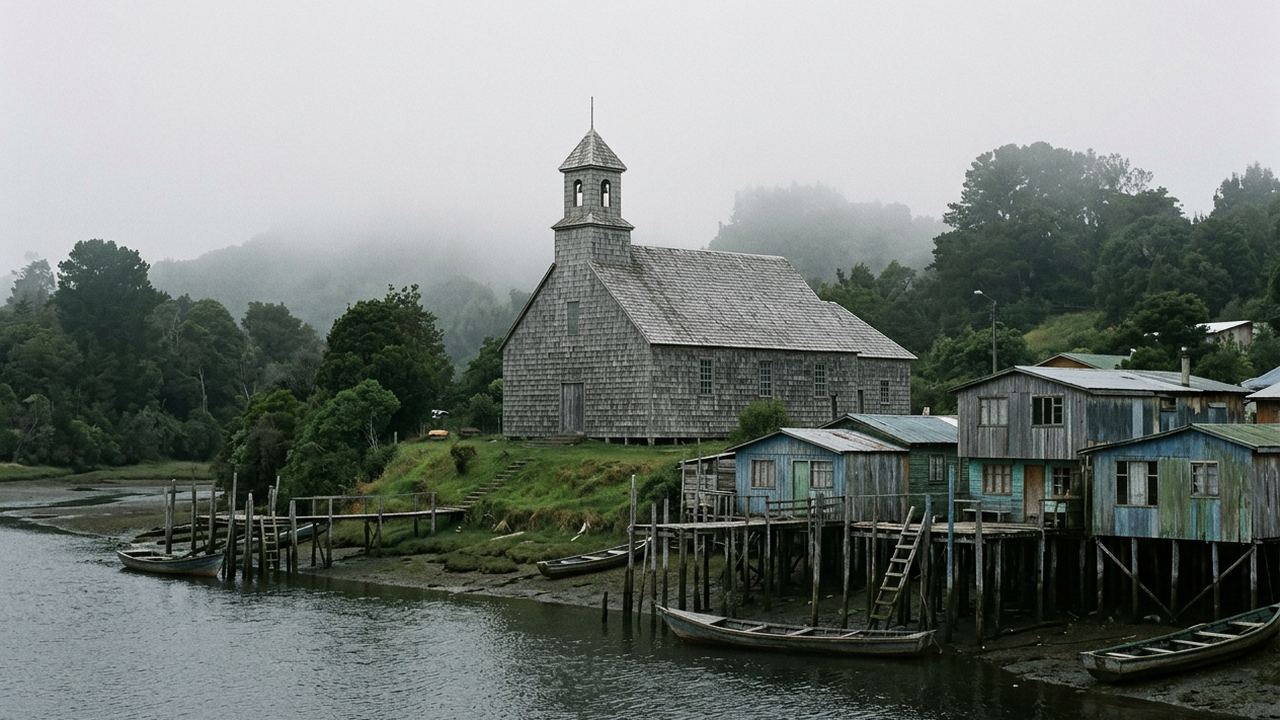
The photographs of Chiloe are almost always taken in the same twenty minutes: low sun on the palafitos at Castro, the stilt houses standing over the water in orange, red and yellow, reflection perfect underneath. That light happens. It happened four times in nine days on the last group we sent. The other days looked like wet green fields under a lid of cloud, and the palafitos looked like what they are, which is ordinary housing built over a tidal channel because the land behind was steep and somebody needed a place to live.
The second thing the photographs leave out is the tide. At Castro the range is around 20 feet. Twice a day the water under the stilt houses drains away and leaves mud, boat hulls lying over, and a smell that people either find interesting or do not. Both states are the real Chiloe. If you are going to arrange your week around one photograph you will spend most of it waiting.
What people get wrong more often is the geography. They assume that because Chiloe is an island off Chile it is a beach place, and it is not. It is on roughly the same latitude south as Portland, Oregon is north, it faces the open Pacific on its western side with nothing between it and New Zealand, and it is cold-temperate rainforest. The interior is bog and pasture. The eastern side, facing the mainland, is a scatter of smaller islands and calm water, and that is where most of the wooden churches and most of the daily life are. The western side is surf, dunes and national park, and it is close to empty.
- The week in one sentence
- Nine nights in four places: three in Castro, two in Cucao near the national park, two on Isla Mechuque reached by launch, and two in Ancud, moving by private vehicle and public ferry, with luggage carried in the vehicle except on the Mechuque leg, where you take an overnight bag.
- Why this and not the next one
- Chiloe sits 700 miles south of Santiago and about 55 miles by road and ferry from the airport at Puerto Montt, which is where flights land. The ground is soft: peat, pasture, black sand, plank walkways over bog. Beds are wooden guesthouses and one family farmhouse, all with heating, none with an elevator. The season runs mid October to late April; outside it many launches stop and half the guesthouses close. Nine nights, from $2,440 per person.
- Inside the figure
- Nine nights of accommodation with private bathrooms on a twin sharing basis; all breakfasts and five dinners; a private vehicle with a Spanish and English speaking driver guide for six of the nine days; all vehicle and passenger ferry fares including the Chacao crossing and the Mechuque launch; national park entry at Chiloe National Park; a half day in a working shingle workshop with the carpenter; a curanto meal cooked in a pit by the family that hosts it on Mechuque; and airport transfers at Puerto Montt in both directions.
- Outside it, and what that runs to
- International and domestic airfare, commonly $1,150 to $1,700 round trip from a middle American hub to Puerto Montt; four dinners, running $12 to $30 each; all lunches, $8 to $18; the single room supplement of $520 for the nine nights; alcohol; laundry, which on the island means a guesthouse charging $10 to $14 a load with a two day turnaround because nothing air dries; the $40 to $60 in cash you will need for launches, small church donations and the market at Dalcahue, since card terminals fail whenever the connection drops; travel insurance, which this office does not sell or advise on; and tips.
- Reasons to book something else
- Do not reserve this if you cannot walk five miles on uneven ground in rain, or if a boat with no cabin and a hard bench for 50 minutes on open water is out of the question. The Mechuque leg has no vehicle access, no pharmacy and no reliable cell signal, and the launch does not run in a strong northerly. Two guesthouses have steep wooden stairs and no ground floor room. If you need a dry, sunny week to consider a trip worthwhile, this is the wrong island.
The ground is peat, the roof is shingle, and both of those are answers to the rain
Take the weather record first, because it decides everything else. Castro has recorded somewhere near 75 inches of rain in an average year, spread across roughly 180 days. That is not monsoon rain. It is a persistent, fine, sideways rain that arrives with a northerly wind and can go on for three days. Summer daytime highs run about 62 to 68 F, winter lows near 40 F, and it does not often freeze. This is a record of what the seasons have been, not a prediction of your week. Any given nine days can come out mostly dry, and some do.
The buildings follow from that. Chilote carpenters clad walls and roofs in alerce and cypress shingles, cut in patterns, overlapped so that water runs off a vertical face rather than sitting on it. The churches, about sixteen of which are inscribed as a World Heritage group, are built with the same techniques a shipwright uses: wooden pegs, curved ceiling ribs like an upturned hull, no nails in the oldest work, no stone at all. They were put up by Jesuit missionaries working with local builders in the seventeenth and eighteenth centuries and then maintained, badly and lovingly, by the villages, which is why the interiors are painted in colors no restorer would have chosen.
A day here has a shape you should know before you commit. It is short on distance and long on transitions. You drive 25 miles, you wait 20 minutes for a launch, you walk a plank path over a field, you sit in a kitchen while somebody explains what the potatoes are. Chiloe grows something over 200 named native potato varieties, which is the sort of fact that sounds like a brochure line until a farmer puts nine of them on a table in front of you and they are visibly different vegetables.
The kind of traveler who does well on nine wet days
This trip works for people who like a place to be inconvenient in a way that makes sense. The ferry runs when the ferry runs. The launch to Mechuque does not go in a strong wind, and if it does not go, you spend the afternoon in Dalcahue instead, which is not a disaster but is also not the plan you had. Roughly 55 percent of the waking hours are decided in advance, which means half your days have a fixed anchor and the rest is yours, and that split is deliberate: fixing more than that on an island where transport is weather dependent produces a schedule that lies to you.
It does not work for people who need a beach, need a pool, or need dinner at nine in a town where most kitchens close at half past eight. It also does not work well as a two night add on to a Patagonia trip, which is how most itineraries treat it. Two nights on Chiloe buys you Castro and one church. Nine buys you the eastern islands, the park, and enough repetition that the weather stops being an event.
The same twenty-four trips are printed in five orders. This one sits in a different place in each, and none of the five positions is a judgement about it.
- Hours in the air
- 19 of 24 at 15 hours. The whole order
- Miles walked a day
- 6 of 24 at 5 miles. The whole order
- Per cent decided in advance
- 18 of 24 at 55 per cent. The whole order
- From, per person
- 7 of 24 at $2,440. The whole order
- Different beds
- 13 of 24 at 4 beds. The whole order
What the season has actually been like, from the record
- Mid October to late November
- Spring. Cold rain, 55 to 62 F, fields at their most violent green, everything open again after winter. Fewest other visitors of the whole open season. Launch cancellations run high.
- December
- Days stretch past nine in the evening. Guesthouse prices climb about 15 percent over spring. Rain still likely on half the days. Good stretch for the western dunes and Cucao.
- Early January to mid February
- Chilean holidays. Castro and Ancud are full, ferry lines at Chacao can take two crossings to clear, and the eastern islands stay quiet anyway. Warmest recorded weeks, 65 to 70 F.
- Third week of February
- The Costumbrista festivals run in several villages: pit cooking, wooden games, accordion. Beds within 20 miles book out months ahead and cost more.
- Late February to March
- The stretch this office suggests most often. School holidays over, water still warm enough for the launches to run reliably, rain returning but not yet constant.
- April
- Southern autumn, the light goes long and gold, dinner options thin out, and around 30 percent of the smaller guesthouses have already closed for the year. Ferry schedule reduces after the third week.
- May to early October
- Closed for this trip. Many launches suspended, some churches locked outside mass, and several days a month when the Chacao crossing halts in high wind.
The curanto is not a show, and the church restoration is uneven
Two honest drawbacks. The first is the curanto. It is a meal cooked in a pit lined with hot stones and covered with nalca leaves: shellfish, pork, chicken, potato bread, sausage. On Mechuque a family cooks it for you, and it takes about three hours from pit to plate, most of which is waiting in a yard. It is not a demonstration staged for visitors, it is a large slow lunch that the family also eats. Some people find those three hours the best part of the trip. Some people find it three hours of standing in drizzle waiting for lunch, and if you know you are the second kind, say so at the request stage and we will price the leg without it.
The second is that the churches vary enormously. Two or three are immaculately restored and worth crossing the island for. Several are locked outside mass hours and the key is with somebody in the village whose whereabouts nobody knows. At least one on any given itinerary is under scaffolding, because a wooden building in 75 inches of rain a year is a permanent maintenance project. Anyone who promises you sixteen churches in nine days is promising you exteriors. We plan for six interiors and usually get four or five, and we would rather tell you that here than have you count them on the ground.
Ferries are the other thing worth saying plainly. The Chacao crossing is a working vehicle ferry with a snack counter and no reservations, it takes about 30 minutes, and in the February peak you may wait through one sailing before you board. That is not a fault in the arrangement. It is the only way onto the island short of flying into Castro's small airport, which few schedules make practical from a United States connection.