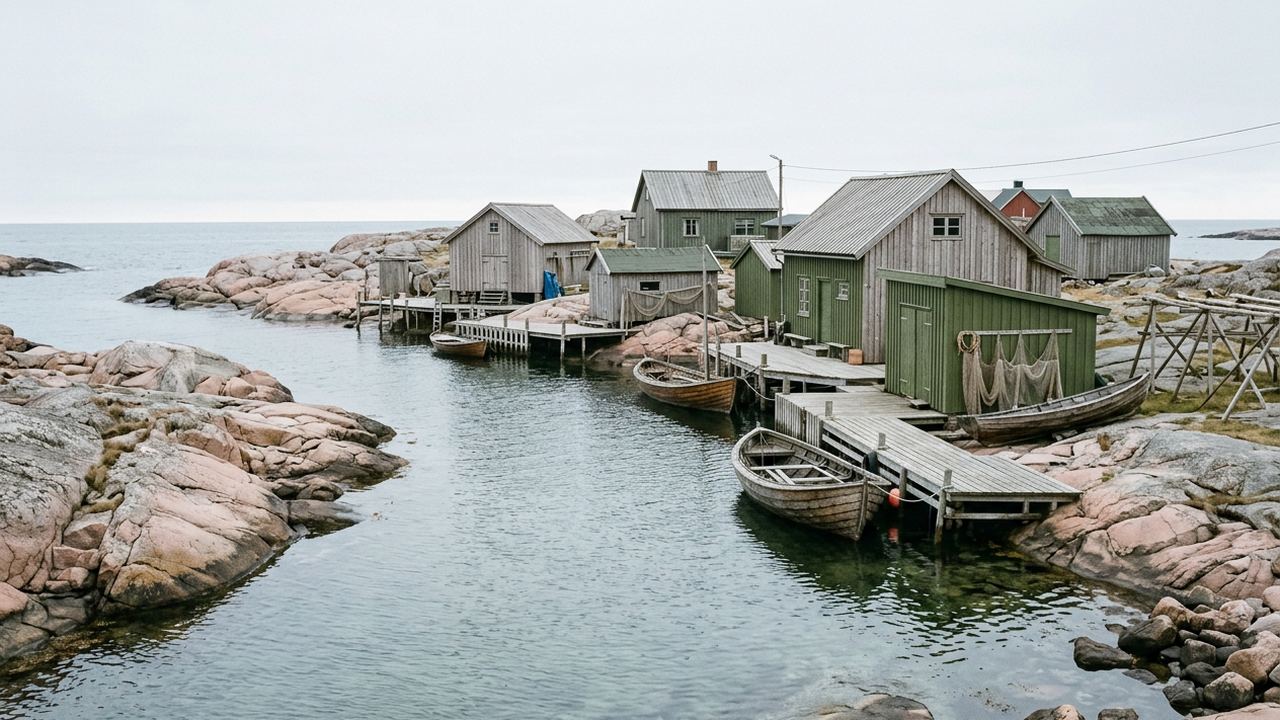
The photographs of this coast are all taken in the same eleven days. They show flat pink rock, a wooden house painted the red that everyone paints houses here, a still harbor, and a swimmer with dry hair. What the frame cuts off is the wind. Bohuslan sits open to the Skagerrak, and the ordinary condition of a July afternoon is fifteen to twenty knots from the southwest, enough to put whitecaps between the islands and to make the sheltered eastern side of every skerry the only comfortable place to sit. People arrive expecting Mediterranean rock and get North Sea rock: the same shape, a different temperature, a different sound.
The second thing the pictures leave out is that this is not one island but several hundred, and that the water between them is public transit. Scheduled passenger ferries run all day in season, they are small, they are on time, and they carry people rather than cars. That is what makes the week work without driving. It also means the day has a spine you do not control. If the 16:40 is the last boat off an island, then the last boat is 16:40, and standing on the quay explaining that you wanted to swim longer does not produce another one.
Third: the fishing villages are working places for part of the year and something else for the rest. Shrimp and langoustine boats still go out, and the harbor at six in the morning is loud with diesel and gulls. By eleven the same harbor is full of visitors eating shrimp on paper plates. Both are true. Nobody is performing.
- The week in one sentence
- Eight nights in four harbor guesthouses, two nights in each, private rooms with shared or private bath depending on the house; the party moves between islands on scheduled passenger ferries and walks the last stretch, carrying its own bags every time.
- Why this and not the next one
- Gothenburg Landvetter is the airport, and the first island is two hours further by bus and boat. The ground is bare pink granite, rounded by ice, wet in the morning and slick with lichen in shade. Beds are small harbor guesthouses, six to fourteen rooms, run by families who also cook dinner. The season opens around the third week of May and closes in the first week of September. From $3,090 per person, two sharing.
- Inside the figure
- Eight nights in four guesthouses with private rooms and daily breakfast; all scheduled passenger ferry fares between the islands; the bus and boat transfer from the airport on arrival and back on departure; two guided sea kayak half days with a local instructor, boats, paddles and buoyancy aids; four dinners in the guesthouses on the nights their kitchens serve; a printed and digital route sheet with ferry times, walking lines and swimming spots; the written figure priced against your dates before you commit; and one named person in Lincoln who answers your email through the trip.
- Outside it, and what that runs to
- Airfare from the United States, which has run $780 to $1,340 round trip from Chicago in the season; lunches and four dinners, budgeting $18 to $34 a head; alcohol, which is expensive and sold in state stores that close early on Saturday and all day Sunday; travel insurance, which this office does not sell or advise on; entry documents of any kind, neither sold nor commented on from this desk; the sauna and cold bath house on the third island at about $22 a person; laundry, at roughly $9 a load in the two houses that have a machine; and anything you break or lose in a kayak.
- Reasons to book something else
- Do not reserve this if you cannot carry your own bag up a stone ramp and along a quarter mile of uneven granite four separate times, or if you cannot get in and out of a kayak from a rocking floating dock without help. Average walking is five miles a day on rock with no handrails and frequent wet slabs, and the guesthouses have stairs and no elevators. Sea temperature peaks near 64F and is often 57F. If cold water is a medical problem for you, half the point of the week is closed.
What the granite does underfoot, and what the sea has actually measured
The rock is Bohus granite, roughly 900 million years old, pink to gray, scraped smooth by the last ice sheet and left with long parallel grooves that run mostly northwest to southeast. Dry, it grips like sandpaper and you can walk it in almost anything. Wet, or in shade where the lichen sits, the same slab becomes genuinely slippery, and the slope that felt like nothing at two in the afternoon is a real fall at eight in the evening. Most injuries on this coast are not dramatic. They are one foot going sideways on a lichen patch with a bag on your back.
There is very little soil. Juniper, heather, crowberry and stunted pine grow in the cracks, and the cracks are where the paths go, which is why walking a mile here can take forty minutes. There are no waymarked trails on most of the small islands and there is nothing to hold on to. This is not a hardship, but it is a pace, and people who plan by mileage are consistently wrong here by half.
On temperature, the record rather than any forecast: through June, July and August the coast has generally run 63F to 72F by day, with the warm end of that arriving in the second half of July, and nights dropping to the low fifties even in high season. Sea temperature has typically climbed from around 54F in early June to a peak near 64F in the first half of August, and a week of hard onshore wind can pull it back four or five degrees in two days by turning over the water. Rain comes through as fronts, not as afternoon showers, and the long summer light means an overcast day is still bright until nine at night. What none of this tells you is what your week will do. It tells you what this coast has been.
Reserve this if you like a plan with holes in it
This week fits people who want the beds, the boats and the route settled and everything else open. Roughly a third of the waking hours are decided: four guesthouses, the ferry legs, and two kayak half days with an instructor. The rest is rock, water and whatever the wind allows. If you like arriving somewhere at ten in the morning with no obligation until dinner, this is a good shape. If a day without a fixed item in it makes you anxious, the arranged-for-you figure of 35 is telling you something real and you should read it as a warning rather than as modesty.
It also fits swimmers specifically. Not lap swimmers: people who will get into 60F water off a rock with no ladder, stay in for four minutes, get out, lie on granite that has been in the sun since six in the morning, and do it again. That is the central pleasure of the place and it is not for everyone. The kayaking is genuine sea kayaking in sheltered water between islands, no experience required, but you will be wet and you will be working.
The same twenty-four trips are printed in five orders. This one sits in a different place in each, and none of the five positions is a judgement about it.
- Hours in the air
- 9 of 24 at 11 hours. The whole order
- Miles walked a day
- 5 of 24 at 5 miles. The whole order
- Per cent decided in advance
- 5 of 24 at 35 per cent. The whole order
- From, per person
- 22 of 24 at $3,090. The whole order
- Different beds
- 12 of 24 at 4 beds. The whole order
What the season has actually been, stretch by stretch
- Late April to mid May
- Almost nothing is open. Guesthouses are painting, ferries run a thin winter timetable, sea around 46F. Cheap flights, no beds, and this trip does not operate.
- Third week of May to mid June
- The season opens. Long light, 57F to 64F air, sea 54F to 57F and cold enough to hurt. Half the harbor kitchens are still finding their feet. The quietest week you will get for the money.
- Mid June to the first week of July
- Midsummer falls here and the coast fills with Swedes for four days, after which it empties again. Beds around Midsummer are the hardest of the year to hold and cost roughly 20 percent more.
- Second week of July to mid August
- Full season. Warmest water of the year, near 64F, every ferry running, every kitchen open, and the harbors genuinely crowded from eleven to four. Expect to share every good swimming rock.
- Mid August to the end of August
- The Swedish holiday ends and the coast goes quiet almost overnight while the water is still at its warmest. Nights turn cool, low fifties. This is the stretch we reserve first and it sells out first.
- First week of September to late September
- Ferries drop to a reduced timetable, several guesthouses close after the first weekend, and the crayfish season fills what remains. Air 55F to 63F, sea falling through 59F. This trip stops running when the boats do.
The awkward part: cost, closing time and the boat you will miss
Sweden is expensive in a way that surprises Americans who have priced the flight and stopped there. A plain lunch of shrimp and bread on a harbor terrace runs $18 to $26. A dinner in a guesthouse that is not included runs $28 to $34 before drinks. A glass of wine is $11 to $14 and beer is not much less, because alcohol above 3.5 percent is sold only through the state monopoly, which shuts at three on Saturday and does not open on Sunday. If you want a bottle for the rock on Sunday afternoon, you buy it on Friday. This catches people every single week, and nobody on the island will sell you a way around it.
The other honest drawback is the timetable. Four island changes in eight nights means four mornings that belong to the ferry rather than to you, and on two of those the connection is tight enough that a slow breakfast will cost you three hours. We build the route to avoid the worst of it, but the boats are a public service run for residents, not a charter, and they will leave without you. There is also weather cancellation: in a hard blow the small outer boats stop, perhaps two or three days a season. If that happens the guesthouse feeds you and you lose the day. We do not pretend otherwise, and there is no compensation for it built into the figure, because nobody on this coast offers one.