Photographs of the Beira Alta almost always crop out the electricity. The plateau is covered in wind turbines, and on the ridge above Manteigas you will see forty of them turning at once, along with the pylons that carry the current down to the coast. Nobody removes them from the view for you. The same photographs tend to catch the boulder fields in low sun, which makes them look like sculpture; in flat midday light they look like what they are, which is a hillside of gray rock with grass between.
The second thing people get wrong is the temperature. This is the coldest part of Portugal and the hottest part of Portugal, sometimes in the same eight days. The plateau sits between 2,300 and 3,300 feet, the range above it reaches 6,539 feet at the Torre, and the interior is four hours from the ocean that moderates everything on the coast. Guests arrive with the wardrobe they packed for Lisbon and spend the first evening buying a fleece in Gouveia.
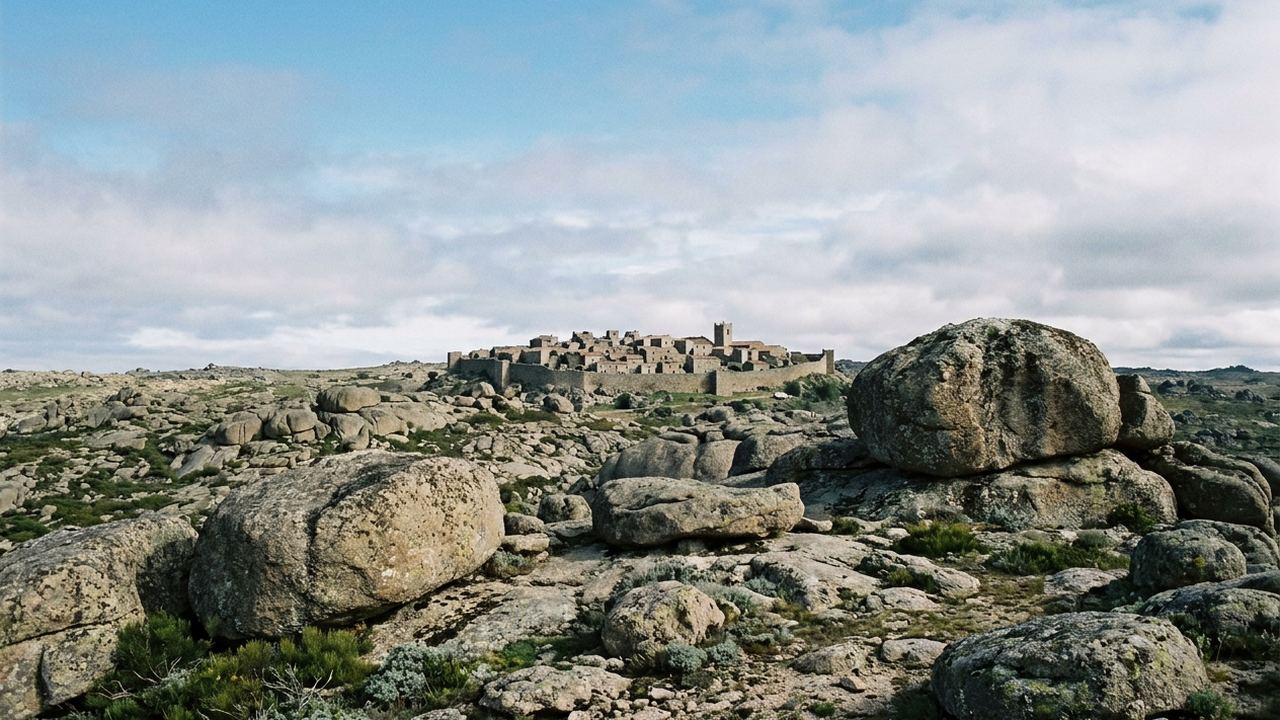
What survives all of that is the building material. Every wall in this region, house, church, pigsty, terrace, boundary, is made from the granite lying in the field next to it. In Sortelha and Monsanto the houses are wedged under and between boulders that were too big to move, so the rock is the fourth wall and the roofline follows it. That is not a curiosity kept for visitors. People live in those houses, park badly outside them, and hang laundry off the boulders.
- The week in one sentence
- Eleven nights in six places: four small rural hotels, one converted granite farmhouse and one night in a guesthouse inside a walled town, with a driver moving the party and the bags by road while you walk or ride between them.
- Why this and not the next one
- The nearest practical airport is Lisbon, then two and a half hours by road northeast, or Porto, then two hours east. The ground is granite: rounded boulders the size of vans, thin soil, dry stone walls, and paths that are rock rather than dirt underfoot. Beds are small family run hotels and one farmhouse, all with private bathrooms, none with an elevator. The season runs late March to late June and then September to early November. From $2,750 per person, two sharing.
- Inside the figure
- Eleven nights of lodging with private bathroom; breakfast every morning; six dinners at the lodging; a driver and vehicle for all transfers between towns and to trailheads; luggage moved door to door; two guided walking days in the Serra da Estrela with a licensed mountain guide; one guided afternoon of the walled towns of the eastern frontier; entry to the castle and cathedral sites on that afternoon; printed and GPS route notes for the unguided days; a phone number in Portugal answered by the ground operator during your stay.
- Outside it, and what that runs to
- International flights, generally $780 to $1,340 round trip from central US airports in the shoulder season; five dinners, roughly $18 to $34 a head with wine in this region; all lunches, $9 to $16 at a village cafe; a rental car if you want one on the free days, from $41 a day plus fuel at about $7.10 a gallon; tips for the guide and driver, customarily $12 to $20 a day between two; the cable car and any lift use at the top of the range, about $10; laundry, which the small hotels charge by the piece at $3 to $5; and any single supplement, $610 for the eleven nights.
- Reasons to book something else
- Do not reserve this if you cannot walk eight miles on uneven granite. The two guided days are nine and ten miles with 2,100 and 2,600 feet of climb, on rock that rolls under the foot and stays wet in shade until midday. Three of the six lodgings have stairs and no elevator, one with 34 steps to the rooms. Village streets are cobbled and steeply pitched. If you need a flat surface, a handrail, or a rest room within a mile, this trip will hurt you rather than tire you.
The rock underfoot, and what a day on it actually costs your legs
The walking here is not hard because of the gradient. It is hard because granite does not compact. On a schist path in the Douro your foot lands flat; here it lands on a curved surface the size of a grapefruit, and every step asks something small of your ankle. Eight miles on this ground tires most people the way eleven or twelve miles of dirt would. Poles help more than boots do, and the two guided days are timed at roughly one and a half miles an hour on the climb rather than the two to two and a half a fit walker expects.
Water is the other thing that shapes a day. The Serra da Estrela is granite over granite, which holds nothing, so the streams are either running hard or they are dry stone channels, with very little in between. In April the glacial valley above Manteigas runs loud enough that you raise your voice to be heard beside it. By late July the same channel is a staircase of dry pools, and the villages that draw from it post signs about it. The route notes for the unguided days tell you where the reliable fountains are, and in three cases they tell you to carry two liters because there is nothing for four hours.
As a record rather than a forecast: over the last decade this plateau has typically seen its last hard frost in the second week of April and its first in the last days of October, with snow lying above 5,000 feet from January into March in most years and in none of the shoulder seasons we sell. Summer afternoons in the valleys have run past 95F often enough that the operator moves the July departures to a dawn start. We do not tell you what your particular week will do, because we do not know.
Reserve this if you would rather be the only foreigner in the room
This trip suits people who are content with dinner in a village where the menu is spoken rather than written, and where nobody at the next table is a visitor. Six of the eleven nights are in places with fewer than twenty rooms. English is spoken at the desk in five of the six and by the guide always; it is not reliably spoken in the cafe, the bakery or the bus station. Guests who enjoy that come back. Guests who find it wearing say so on night four.
It also suits people who want a fixed frame and loose contents. Roughly 45 percent of your waking hours are decided in advance: the transfers, the two guided mountain days, the walled towns afternoon, and six of the dinners. The rest of the time you have route notes, a village, and no obligation to anyone. If you would prefer everything filled, this is the wrong trip. If you would prefer nothing fixed, you do not need an office to make the arrangements.
The same twenty-four trips are printed in five orders. This one sits in a different place in each, and none of the five positions is a judgement about it.
- Hours in the air
- 8 of 24 at 11 hours. The whole order
- Miles walked a day
- 17 of 24 at 8 miles. The whole order
- Per cent decided in advance
- 8 of 24 at 45 per cent. The whole order
- From, per person
- 14 of 24 at $2,750. The whole order
- Different beds
- 20 of 24 at 6 beds. The whole order
What the last several seasons have actually been like on this plateau
- Late March to mid April
- Cold mornings near 38F, afternoons around 62F, the high passes often still shut by snow. Wildflowers in the terraces, streams full. Some rural hotels open only from the first weekend of April.
- Mid April to end of May
- The strongest stretch on the record: 70F afternoons, long light, everything open, water running everywhere. Also the busiest, so lodging is confirmed earliest and the price sits at the top of the band.
- June
- Hot by noon in the valleys, often above 86F, but comfortable at altitude. Walks start at 7am. Village festivals in the second half of the month fill rooms in Trancoso and Belmonte without warning.
- July and August
- Regularly 95F to 104F on the plateau, and fire restrictions close some tracks at short notice. We do not sell these dates. Anyone who insists is told plainly what the ground has been like.
- September to mid October
- Second best on the record. Warm days near 75F, cold nights, grape harvest in the lower valleys, water low. Chestnuts from the first week of October, which changes what is on the plate.
- Late October to early November
- Afternoons around 57F, first frosts, fog sitting in the Mondego valley until eleven some mornings. Quiet, cheap to reach, and the season closes when the farmhouse shuts its heating on for winter guests only.
The drive nobody warns you about, and the night you may want to skip
The transfer from Lisbon is two and a half hours on good highway, and then the last forty minutes are not. The roads up onto the plateau and into the range are narrow, walled on both sides by that same granite, and switchbacked hard enough that people who read in cars should not. The driver knows this and will stop. It is still the part of the trip guests complain about, and it happens twice more in the eleven nights, going in and out of Manteigas.
The other honest drawback is the walled town night. Sleeping inside Sortelha or Monsanto is the memory most people take home, and it is also the least comfortable bed on the trip: thick granite walls, small windows, a bathroom that was carved into a corner in the 1990s, and no vehicle access to the door, which means carrying your own bag up a cobbled lane for about 200 yards. We can swap that night for a modern hotel eight miles downhill at no change in price. About one party in five does. Neither choice is the right one and we will not tell you which to take.